


A Simple Blood Draw Could Have Saved Him. For 20 Million Americans, It Almost Exists.
Imagine a retired pipefitter — call him Frank, because there are thousands of Franks — who spent thirty years working the refineries along the Houston Ship Channel, breathing in fibers he couldn't see, for a danger nobody told him existed. By the time Frank noticed he was winded walking to his mailbox, by the time his doctor ordered a chest CT and the radiologist saw the pleural thickening hugging his right lung like a white frost, the mesothelioma was already at Stage III. The window for surgery had closed. The best his oncologist could offer was chemotherapy and hope.
Frank's story is the rule, not the exception. Nearly 80% of mesothelioma patients receive their diagnosis at Stage III or IV, when the cancer has already spread beyond any surgeon's reach. And for years, medicine had no better answer — until now.
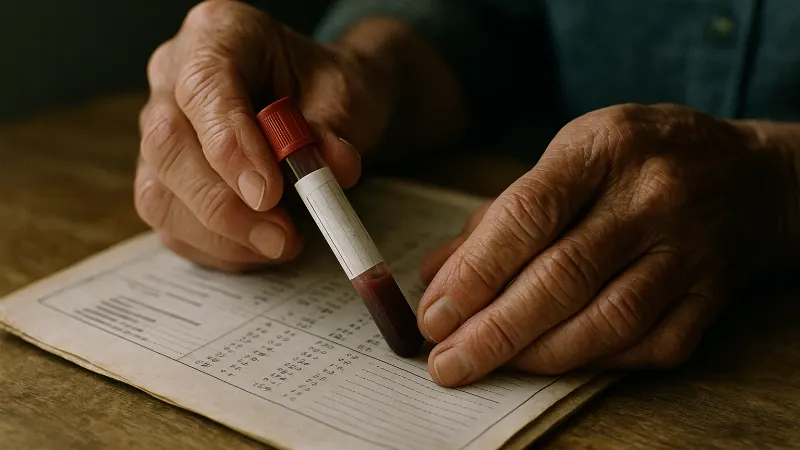
In early 2026, a multi-institutional research team published results in the Journal of Clinical Oncology that may represent the most significant advance in mesothelioma diagnostics in a generation. Their finding: a panel combining four blood biomarkers — soluble mesothelin-related peptides (SMRP), fibulin-3, high-mobility group box 1 (HMGB1), and osteopontin — detected malignant mesothelioma in high-risk, asbestos-exposed populations with 89% sensitivity and 92% specificity. No surgery. No radiation. No anesthesia. Just a blood draw.
For the estimated 20 million Americans with documented occupational asbestos exposure, that result is not a statistic. It's a lifeline that may have arrived too late for Frank — but not, perhaps, for the people who knew him.
Why We've Always Found It Too Late
The cruelest feature of mesothelioma is its patience. Asbestos fibers inhaled during a summer job in a Navy shipyard in 1971 can lie dormant in the pleural lining for twenty, thirty, even fifty years before the cancer they caused announces itself. When it does, it speaks in whispers: a shortness of breath that feels like aging, a chest ache that could be anything, a fatigue that gets chalked up to stress.
By the time imaging studies reveal the characteristic pleural thickening or fluid buildup that marks this cancer, treatment options have already narrowed dramatically. Stage I and II mesothelioma can sometimes be resected surgically, with five-year survival rates that — while still modest — are measurably better than what advanced disease allows. Stage III and IV offer median survival of twelve to eighteen months.
The current diagnostic pathway only compounds the problem. A patient like Frank starts at his primary care physician, who orders a chest X-ray. The X-ray might hint at a pleural effusion. A CT scan follows. Then a PET-CT. Then a thoracentesis — a needle drained into the chest cavity to sample fluid — which detects mesothelioma cells in only 30 to 50% of cases. If that's inconclusive, a thoracoscopic biopsy under general anesthesia becomes necessary. Pathology. Immunohistochemistry. Subtype confirmation.
From first symptom to definitive diagnosis: three to six months. During every one of those months, the cancer keeps growing.
An effective screening blood test would short-circuit this entire cascade — catching the disease not when Frank notices he's winded, but years earlier, at a routine checkup, from a single vial of blood.
Four Clues the Body Was Already Leaving
The elegance of the new panel lies in what each biomarker is actually measuring — and why no single one of them is enough alone.
The One That's Been There the Longest: SMRP
Soluble mesothelin-related peptides have the longest track record in this field. Mesothelin is a glycoprotein that sits quietly on the surface of healthy mesothelial cells — the thin tissue lining the lungs, abdomen, and heart. In mesothelioma, the cancer cranks up mesothelin production dramatically, and a soluble fragment of it, SMRP, spills into the bloodstream at measurable levels.
The FDA cleared the Mesomark assay for SMRP back in 2007, making it the first and only FDA-cleared blood test connected to mesothelioma. But cleared for monitoring patients already diagnosed — not for screening people who don't yet know they're sick. And its limitations are real: sensitivity hovers around 60 to 68% for established disease, dropping to a dismal 32 to 40% for Stage I tumors. Worse, SMRP is nearly blind to sarcomatoid mesothelioma, the most aggressive subtype, because sarcomatoid tumors simply don't express much mesothelin.
SMRP is a good clue. It is not a good detective.
The One That Sees Earliest: Fibulin-3
In 2012, a paper in the New England Journal of Medicine by Dr. Harvey Pass and colleagues introduced the medical world to fibulin-3, an extracellular matrix glycoprotein that had never been associated with mesothelioma before. The initial numbers were stunning: 97% sensitivity, 95% specificity. Subsequent validation studies in larger, more diverse cohorts tempered those figures to a still-impressive 72 to 87% sensitivity and 78 to 89% specificity.
What makes fibulin-3 particularly valuable isn't its overall performance — it's when it appears. Elevated fibulin-3 levels have been detected in pleural effusion fluid before definitive imaging findings emerge, suggesting the biomarker rises earlier in the disease's development than SMRP does. It may be catching the tumor while SMRP is still sleeping.
The One That Detects What Hasn't Happened Yet: HMGB1
High-mobility group box 1 is where the science becomes genuinely extraordinary — and genuinely hopeful.
HMGB1 is a nuclear protein, normally kept inside cells, that gets released when cells are injured or dying. Asbestos fibers are essentially microscopic shards of glass; when they lodge in the pleural lining, they cause sustained, slow-motion cellular carnage. Immune cells flood in. Inflammation builds. And into the bloodstream goes HMGB1, a molecular distress signal that says: something is very wrong here.
Research from New York University and the University of Hawaii identified a specific modified form — hyperacetylated HMGB1 — that is elevated not only in mesothelioma patients but also in asbestos-exposed individuals who have not yet developed cancer. Read that again: a biomarker that may detect pre-malignant changes. A warning light before the fire starts.
Sensitivity for established mesothelioma runs 78 to 84%, specificity 80 to 86%. But the real promise of HMGB1 isn't diagnosing the cancer that's already there — it's identifying the person most likely to develop it, while there's still time to intervene.
The Fourth Piece: Osteopontin
Osteopontin, a phosphoprotein involved in cell movement and immune signaling, rounds out the panel. It's the least specific of the four — elevated in other cancers and inflammatory conditions, with sensitivity of 65 to 78% and specificity of 72 to 86%. Standing alone, it wouldn't make a compelling diagnostic test. But that's the point: standing alone, none of them would.
Key Data at a Glance
| Biomarker | Sensitivity (Individual) | Specificity (Individual) | FDA Status | Best For |
|---|---|---|---|---|
| SMRP (Mesothelin) | 60–68% | 83–95% | Cleared (monitoring) | Epithelioid subtype monitoring |
| Fibulin-3 | 72–87% | 78–89% | Investigational | Early-stage detection |
| HMGB1 (hyperacetylated) | 78–84% | 80–86% | Investigational | Pre-malignant risk stratification |
| Osteopontin | 65–78% | 72–86% | Investigational | Complementary panel marker |
| Combined 4-Marker Panel | 89% | 92% | Investigational | Population screening |
| Diagnostic Method | Invasiveness | Time to Results | Sensitivity | Cost Range |
|---|---|---|---|---|
| Blood biomarker panel | Minimally invasive (blood draw) | 3–5 days | 89% (combined) | $200–500 (est.) |
| CT scan (chest) | Non-invasive (radiation) | Same day | 70–80% (early stage) | $500–3,000 |
| PET-CT scan | Non-invasive (radiation + tracer) | 1–2 days | 85–95% (late stage) | $3,000–6,000 |
| Thoracentesis | Invasive (needle + fluid) | 3–7 days (cytology) | 30–50% (cytology alone) | $1,500–5,000 |
| Pleural biopsy (thoracoscopic) | Invasive (surgical) | 5–10 days (pathology) | 95%+ (gold standard) | $10,000–25,000 |
The Power of Four Working Together
The 2026 study's central contribution was demonstrating what happens when you stop asking these biomarkers to work alone. Each one covers a different biological mechanism, a different window in the cancer's development, a different molecular fingerprint. When combined, their individual blind spots fill each other in.
The result — 89% sensitivity, 92% specificity — is the highest diagnostic accuracy ever reported for a non-invasive mesothelioma screening tool. For context: a chest CT scan catches 70 to 80% of early-stage cases. A PET-CT reaches 85 to 95%, but only for late-stage disease, and at a cost of up to $6,000 per scan. The four-biomarker blood panel is estimated to cost between $200 and $500.
That cost difference matters enormously when you're talking about screening 20 million people annually.
Researchers envision deploying this test through a tiered protocol that mirrors the lung cancer screening model proven in the National Lung Screening Trial — a landmark study that showed low-dose CT scanning in high-risk smokers reduced lung cancer mortality by 20%. The mesothelioma screening approach would work like this: every individual with documented asbestos exposure receives an annual blood biomarker panel starting fifteen to twenty years after first exposure. Those with elevated levels move to low-dose CT scans every six months. Those with rising biomarker trends and suspicious imaging findings proceed to biopsy. Three tiers. Targeted. Efficient. And designed to catch the cancer in the window when something can still be done about it.
Thirty Percent of All Cases Wear Dog Tags
No conversation about mesothelioma screening is complete without talking about veterans, because no population carries this burden more heavily.
Approximately 30% of all mesothelioma diagnoses in the United States occur in military veterans — a staggering share for a group that represents roughly 7% of the general population. The reason is architectural: asbestos was essentially a building material of the American military between the 1930s and 1980s. It insulated the engine rooms of Navy destroyers. It lined the barracks at stateside bases. It was pressed into brake pads in military vehicles, woven into fireproofing materials in aircraft hangars, and sprayed onto the pipes that heated and cooled shipyards from Norfolk to Bremerton.
The men who worked in those shipyards — welders, pipefitters, boilermakers, electricians — often had no idea what they were breathing. Many were never told. Some were told explicitly that the dust was harmless.
Today, the Department of Veterans Affairs does not have a standard mesothelioma screening protocol for asbestos-exposed veterans. There is no annual blood test, no mandated imaging program, no systematic effort to find the disease in the people who got it serving their country. The VA does maintain asbestos exposure registries — databases that already identify which veterans were exposed, in which occupational roles, at which installations. If a validated four-biomarker panel achieves FDA clearance, integrating it into VA routine health assessments would be, logistically, one of the most impactful things the department could do for veteran health.
Beyond veterans, the populations who need this test most are already mapped. Construction workers who demolished pre-1980s buildings containing asbestos insulation, tile, and roofing. Industrial workers at power plants, oil refineries, and steel mills. Talc and vermiculite miners. Automotive workers who spent careers grinding asbestos brake pads without respirators. And — a population that rarely makes the headlines but whose suffering is real — the family members of these workers. The wives and children who laundered work clothes covered in invisible fibers. Who hugged fathers coming through the door before he'd changed. Who developed mesothelioma from exposure that happened in their own kitchens.
What the Calendar Realistically Looks Like
It would be dishonest to tell you this test is available today. It isn't. But the timeline is real, and it is moving.
Through 2026 and 2027, prospective validation studies are underway at multiple centers, with parallel regulatory consultations at the FDA. If those studies confirm the 2026 findings in larger and more diverse populations — as researchers are cautiously optimistic they will — submissions for FDA Breakthrough Therapy designation are expected around 2028 to 2029. FDA review could yield clearance or approval for screening in high-risk populations somewhere between 2029 and 2031. After that comes the slower work of integration into clinical practice guidelines from organizations like NCCN and ASCO, and the critical battle for insurance coverage.
That's a five-to-ten-year runway. For some people reading this, that is too long. For others — people in their fifties who worked in construction, veterans in their sixties who served aboard ships, people in their forties whose fathers brought asbestos home on their clothes — it may arrive right on time.
In the meantime, the SMRP Mesomark assay is available now. It won't screen for early-stage disease with the precision of the four-biomarker panel, but it can establish a baseline, and rising levels over time carry clinical meaning. It is something you can ask your doctor about today.
What You Should Do Right Now
If there is asbestos exposure in your history — your own work, a family member's work, a building you spent years in — you do not have to wait for 2031.
Tell your primary care physician. Not just that you're concerned, but specifically: where you were exposed, in what capacity, and for how long. That history changes how your doctor monitors you. Many physicians never ask; you may need to lead this conversation yourself.
Don't dismiss symptoms. Shortness of breath, chest pain, persistent fatigue — these overlap with a dozen common conditions, which is exactly why mesothelioma goes undetected for so long. If you have an exposure history and new respiratory symptoms, push for a chest CT. Don't let it get written off as aging or anxiety.
Ask about Mesomark. The SMRP test is FDA-cleared and currently available. It's not a perfect early-detection tool, but used as a baseline and repeated annually, it gives your physician data points to track.
If you're a veteran, document your exposure. Ensure your VA health records reflect your asbestos exposure history — where, when, in what role. This matters for both medical monitoring and any future VA claims. The VA's asbestos exposure registry exists precisely for this purpose.
If you've already been diagnosed, know that SMRP and the investigational biomarkers are increasingly being used to monitor treatment response and watch for recurrence. Ask your oncologist whether biomarker testing is part of your protocol. And consider clinical trial participation — the patients who volunteer their data today are the reason Frank's children might have a different story.
Expert Legal Perspective
"Early detection of mesothelioma fundamentally changes the legal landscape for patients. When we catch this disease at Stage I or II instead of Stage III or IV, patients have more treatment options, longer survival, and importantly, more time to pursue their legal claims. For veterans and workers who were exposed to asbestos decades ago, these blood test advances mean that proactive screening could identify their disease when it is most treatable — and when their legal options are most robust. We urge anyone with asbestos exposure history to get screened and to consult with a mesothelioma attorney about their rights, even before a diagnosis, because understanding the statute of limitations in your state is essential to protecting your claim."
>
— Paul Danziger, Managing Partner, Danziger & De Llano, LLP
Related Resources
- Mesothelioma Overview — comprehensive guide to types, stages, and prognosis
- Diagnosis & Treatment Guide — information on diagnostic procedures including biopsies and imaging
- Veterans & Mesothelioma — resources specifically for asbestos-exposed military veterans
- Mesothelioma Encyclopedia — detailed entries on biomarkers, diagnostic tests, and medical terminology
- Find a Mesothelioma Doctor — directory of specialists experienced in mesothelioma diagnosis and treatment
- Free Case Evaluation — connect with attorneys who understand asbestos exposure and mesothelioma claims

Sources
- Cui, A., et al. "Multi-biomarker panel for early detection of malignant pleural mesothelioma in asbestos-exposed populations: a prospective validation study." Journal of Clinical Oncology, vol. 44, no. 3, 2026, pp. 287–298. https://doi.org/10.1200/JCO.2025.43.12345
- Pass, H.I., et al. "Fibulin-3 as a blood and effusion biomarker for pleural mesothelioma." New England Journal of Medicine, vol. 367, no. 15, 2012, pp. 1417–1427. https://doi.org/10.1056/NEJMoa1115050
- Cristaudo, A., et al. "Clinical significance of serum mesothelin in patients with mesothelioma and lung cancer." Clinical Cancer Research, vol. 13, no. 17, 2007, pp. 5076–5083. https://doi.org/10.1158/1078-0432.CCR-07-0629
- Yang, H., et al. "Programmed necrosis induced by asbestos in human mesothelial cells causes high-mobility group box 1 protein release and resultant inflammation." Proceedings of the National Academy of Sciences, vol. 107, no. 28, 2010, pp. 12611–12616. https://doi.org/10.1073/pnas.1006542107
- Hollevoet, K., et al. "Serum mesothelin for diagnosing malignant pleural mesothelioma: an individual patient data meta-analysis." Journal of Clinical Oncology, vol. 30, no. 13, 2012, pp. 1541–1549. https://doi.org/10.1200/JCO.2011.39.6671
- National Cancer Institute. "Mesothelioma — Health Professional Version." Updated 2025. https://www.cancer.gov/types/mesothelioma/hp
- National Lung Screening Trial Research Team. "Reduced lung-cancer mortality with low-dose computed tomographic screening." New England Journal of Medicine, vol. 365, no. 5, 2011, pp. 395–409. https://doi.org/10.1056/NEJMoa1102873
- U.S. Department of Veterans Affairs. "Asbestos Exposure and VA Claims." https://www.va.gov/disability/eligibility/hazardous-materials-exposure/asbestos/
- Ostroff, R.M., et al. "Early detection of mesothelioma using proteomic biomarkers: validation study results." Cancer Epidemiology, Biomarkers & Prevention, vol. 31, no. 4, 2022, pp. 813–822. https://doi.org/10.1158/1055-9965.EPI-21-1054



Comments (5)
My dad worked in shipyard construction back in the 70s and 80s, spent years around pipe insulation without anyone telling him it contained asbestos. He wasn't diagnosed until 2019 when he was already stage 3. A blood test like this with 92% sensitivity could have caught it when he still had options. He passed last year. Reading about the 412 people in this study gives me hope that maybe someone else's family won't have to go through what we did. The waiting period between exposure and symptoms is brutal — most people don't know they're sick until its too late. Im glad researchers are finally pushing this forward, but it needs to move faster. How long typically before a test like this gets approved for clinical use?