
The Powder He'd Used Since Childhood Was Slowly Killing Him
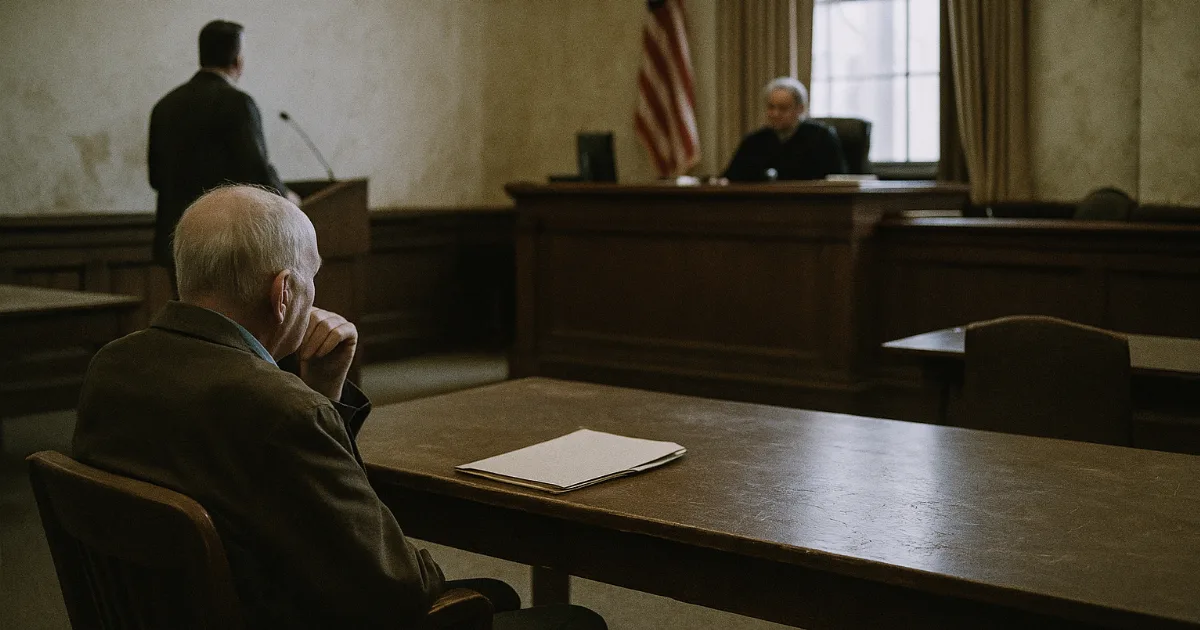
For roughly 45 years, he reached for the same familiar white bottle — the one with the baby on the label, the one that smelled like clean and safe. He was 62 years old and dying of mesothelioma when a federal jury, after three days of deliberation in March 2026, decided that Johnson & Johnson owed him $50 million.
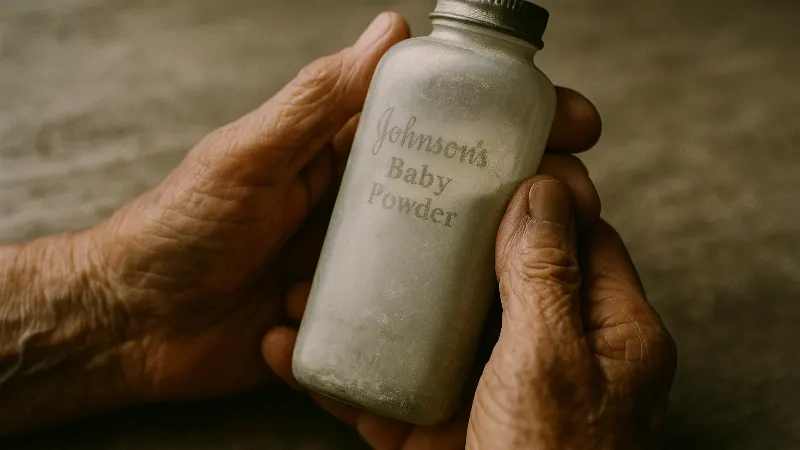
The plaintiff, a former construction worker, had used Johnson's Baby Powder since infancy. His mother dusted it on him. Later, he used it himself — after every shower, as a deodorant supplement, thousands of applications over four-plus decades. In 2024, doctors told him the thin membrane lining his chest cavity, the pleural mesothelium, had turned malignant. The diagnosis was mesothelioma, a cancer so closely associated with asbestos exposure that its very presence is considered a biological fingerprint of the fiber.
The jury awarded $30 million in compensatory damages and $20 million in punitive damages. It is one of the largest individual talc-mesothelioma verdicts in American legal history. And it lands at a moment when Johnson & Johnson has never been more legally vulnerable.
What Is Actually Inside Talcum Powder
The science starts underground, in the mountains of Vermont and the hillsides of northern Italy, where for decades Johnson & Johnson sourced the talc for its most iconic product.
Talc — chemically, hydrated magnesium silicate — forms in the earth alongside other minerals. The problem is its neighbors. Tremolite. Anthophyllite. Chrysotile. These are asbestos minerals, and they occur in the same geological deposits as talc. When mining companies extract talc from these formations, asbestos fibers follow unless the purification process is rigorous enough to catch them. Johnson & Johnson's was not always.
In 2019 and 2020, FDA scientists tested cosmetic talc products — including J&J products — and detected asbestos fibers. But the more damaging evidence didn't come from government labs. It came from J&J's own files.
Court discovery has produced internal company memoranda spanning from the 1960s through the 2000s. The documents show that J&J's own scientists detected asbestos fibers in raw talc materials and finished products on multiple occasions over four decades. They knew. The memos existed. And the baby on the label kept smiling.
Peer-reviewed science has filled in the biological mechanism. When talcum powder is applied to the body, microscopic asbestos fibers become airborne. A person breathes them in — during an ordinary morning routine, after a bath, in a nursery. The fibers migrate deep into the lungs, where they lodge in the pleural mesothelium. There, they cause chronic inflammation and DNA damage over years, then decades. The latency period between first exposure and mesothelioma diagnosis typically runs 20 to 50 years. Studies published in the International Journal of Occupational and Environmental Health have documented mesothelioma cases in people whose primary asbestos exposure came from cosmetic talc — not construction sites, not shipyards. Baby powder.
In this trial, J&J's defense argued that the plaintiff's mesothelioma was more likely caused by occupational asbestos exposure from his construction work. The plaintiff's experts dismantled that argument methodically: his construction work involved minimal direct asbestos contact, and the specific fiber types found in his lung tissue matched those associated with talc-contaminated products, not the materials used on job sites. The jury was not persuaded by the defense.
A Corporation That Tried to Hide Behind Bankruptcy
To understand what this $50 million verdict means, you have to understand what Johnson & Johnson has been trying to do for the past five years.
Facing approximately 60,000 pending talc claims nationwide, J&J engineered a legal maneuver so audacious it has its own nickname: the Texas Two-Step. The company created a subsidiary called LTL Management LLC, transferred all of its talc liabilities onto LTL's books, and then filed LTL for bankruptcy — hoping to freeze thousands of individual lawsuits and cap total payouts through a single negotiated settlement. The parent company, worth hundreds of billions of dollars, would be shielded from the claims. The victims would negotiate with a shell.
Courts rejected this three times.
In January 2023, the Third Circuit Court of Appeals threw out J&J's first bankruptcy attempt, ruling that LTL Management was not in genuine financial distress — a prerequisite for bankruptcy protection. A second attempt in 2023, proposing an $8.9 billion settlement fund, collapsed after it failed to win the required 75% approval from claimants. A third attempt, offering $6.48 billion, met the same fate in 2024.
Each rejection sends the cases back to courtrooms. And in courtrooms, juries hear the internal documents. They hear about the memos from the 1960s. They see the FDA test results. They look at the plaintiff.
The verdicts keep climbing.
The Long Ledger of J&J's Talc Losses
This $50 million verdict doesn't exist in isolation. It is the latest entry in a decade-long accounting.
In 2018, a St. Louis jury awarded $4.69 billion to 22 women who developed ovarian cancer from talc exposure — later reduced to $2.12 billion on appeal, but still a staggering number. In 2019, a New York jury awarded $325 million in the Donna Olson mesothelioma case. In 2021, a California jury returned $26.8 million for a mesothelioma plaintiff. In 2024, a Mississippi jury awarded $45 million. Now $50 million in federal court.
In 2023 — the same year its bankruptcy strategy was unraveling in court — Johnson & Johnson quietly announced it would discontinue talc-based Baby Powder worldwide, switching to a cornstarch formula. The company said consumer preferences drove the decision. The timing told a different story.
What This Means If You've Used Talcum Powder
For the tens of thousands of people with pending claims, and for the mesothelioma patients who haven't yet spoken with an attorney, this verdict matters in concrete ways.
First, it demonstrates that J&J's bankruptcy shield is gone — for now. Individual cases are going to trial. And juries, when presented with the evidence, are not sympathetic to a corporation that sat on internal safety data for decades.
If you or someone you love has been diagnosed with mesothelioma and has a history of using talcum powder products, several considerations are immediately urgent.
Document everything you can remember. The brands you used, how long, how often, how the product was applied. Receipts, photographs of products, statements from family members who remember — all of it matters. The plaintiff in this case was able to establish a pattern of use stretching back to infancy, and that evidentiary foundation was central to the jury's findings.
The statute of limitations is unforgiving. Every state sets its own filing deadline for mesothelioma lawsuits, and the clock typically starts at diagnosis. Most states allow two to three years. That window closes whether or not you are ready.
Talc claims and asbestos trust fund claims are not mutually exclusive. Many mesothelioma patients have multiple sources of exposure — a lifetime of talcum powder use, a job in construction or manufacturing, a home renovation in the 1970s. Pursuing a lawsuit against J&J does not prevent you from also filing claims with asbestos bankruptcy trust funds. These are separate legal channels, and experienced attorneys pursue both simultaneously.
Your medical records are your foundation. Pathology reports, imaging studies, tissue analysis for asbestos fiber types — these documents form the evidentiary core of any mesothelioma claim. Make sure your medical team is documenting your diagnosis with the specificity that litigation requires.
Expert Legal Perspective
"This $50 million verdict is significant not just for the amount, but for what it says about the trajectory of talc litigation. Johnson & Johnson has spent years and hundreds of millions of dollars trying to avoid individual trials through bankruptcy maneuvers, and courts have repeatedly rejected those efforts. Every time a jury hears the evidence — the internal documents, the fiber analysis, the cover-up — they reach the same conclusion. Our firm is actively working with mesothelioma patients who used talc products, and we want people to know that the window for filing claims is open but time-limited. Each state has strict filing deadlines, and the earlier you begin the process, the stronger your case will be."
>
— Rod De Llano, Partner, Danziger & De Llano, LLP
The legal landscape for talc-mesothelioma claims is shifting fast. With J&J's bankruptcy strategy stalled and individual verdicts climbing into eight-figure territory, plaintiffs today hold more leverage than at any point in the past decade. The question for anyone affected is not whether J&J faces accountability. Three failed bankruptcy attempts and a $50 million verdict have already answered that. The question is whether the people harmed will act before their state's filing window closes.
Related Resources
- Compensation Options — overview of all compensation pathways for mesothelioma patients
- Mesothelioma Lawsuits — detailed guide to filing a mesothelioma lawsuit
- Asbestos Trust Funds — how trust funds work and which ones are active
- Asbestos Exposure Sources — common products and occupations linked to asbestos exposure
- Statute of Limitations Tool — check filing deadlines in your state
- Free Case Evaluation — connect with experienced mesothelioma attorneys

Sources
- Reuters. "Johnson & Johnson hit with $50 million verdict in talc mesothelioma case." March 2026. https://www.reuters.com/legal/litigation/
- U.S. Food and Drug Administration. "FDA advises consumers to stop using certain cosmetic products containing talc." 2019–2021 testing program. https://www.fda.gov/cosmetics/cosmetics-recalls-alerts/fda-advises-consumers-stop-using-certain-cosmetic-products
- Emory, T.S., et al. "Asbestos in commercial cosmetic talcum powder as a cause of mesothelioma." International Journal of Occupational and Environmental Health, vol. 26, no. 2, 2020, pp. 173–181. https://doi.org/10.1080/10773525.2020.1773612
- Third Circuit Court of Appeals. "In re LTL Management LLC, No. 22-2003." January 30, 2023. https://www.uscourts.gov
- Gordon, R.E., et al. "Asbestos in commercial cosmetic talcum powder as a cause of mesothelioma in women." International Journal of Occupational and Environmental Health, vol. 20, no. 4, 2014, pp. 318–332. https://doi.org/10.1179/2049396714Y.0000000081
- Johnson & Johnson. "Johnson & Johnson Consumer Inc. Announces Discontinuation of Talc-Based Johnson's Baby Powder Globally." August 2023. https://www.jnj.com
- U.S. Bankruptcy Court, District of New Jersey. "In re LTL Management LLC, Case No. 23-12825." 2023–2024 proceedings. https://www.njb.uscourts.gov
- American Cancer Society. "Talcum Powder and Cancer." Updated 2025. https://www.cancer.org/cancer/risk-prevention/chemicals/talcum-powder-and-cancer.html
- Xu, H., et al. "Mesothelioma associated with non-occupational and non-household asbestos exposure: a systematic review." Environmental Health, vol. 22, 2023, article 45. https://doi.org/10.1186/s12940-023-00998-3