


TTFields Device Shows Meaningful Survival Benefit for Mesothelioma Patients
Tumor Treating Fields (TTFields), a wearable medical device that uses alternating electric fields to disrupt cancer cell division, has demonstrated statistically significant survival improvements in patients with unresectable malignant pleural mesothelioma. Results from the STELLAR trial, a single-arm phase II study, showed a median overall survival of 18.2 months when TTFields was combined with standard chemotherapy — a meaningful improvement over the historical benchmark of 12.1 months with chemotherapy alone. Novocure, the medical device company behind TTFields technology, has been advancing this treatment through regulatory pathways, and the device (marketed as the NovoTTF-100L system) received FDA humanitarian device exemption (HDE) approval for mesothelioma in 2019. For patients with a disease that has seen few treatment advances in two decades, TTFields represents a genuinely novel mechanism of action and a new tool in the limited mesothelioma treatment arsenal. The key question for patients and families is practical: how does it work, what does wearing it involve, what does it cost, and who is a good candidate?
Deep Analysis: How TTFields Technology Works
The Science Behind Tumor Treating Fields
TTFields work on a fundamentally different principle than chemotherapy, radiation, or immunotherapy. Rather than poisoning cancer cells (chemotherapy), damaging their DNA (radiation), or unleashing the immune system against them (immunotherapy), TTFields physically interfere with cell division using low-intensity, intermediate-frequency alternating electric fields.
Here is how the mechanism works at the cellular level:
- Disrupting mitotic spindle formation: When a cell divides, it forms a structure called the mitotic spindle — a network of protein filaments (tubulin) that pulls chromosomes apart. These tubulin proteins have strong electrical dipole moments, meaning they respond to electric fields. TTFields cause these proteins to align abnormally, preventing the spindle from forming correctly.
- Dielectrophoretic effects: During the final stages of cell division (cytokinesis), the dividing cell forms a narrow "neck" called the cleavage furrow. The electric field concentrates in this narrow region, creating forces that push charged organelles and macromolecules toward the furrow. This disrupts the orderly division process.
- Selective targeting of dividing cells: TTFields primarily affect cells that are actively dividing. Since cancer cells divide much more frequently than most normal cells, the treatment preferentially targets tumor cells while largely sparing surrounding healthy tissue.
- Inducing immunogenic cell death: Research has shown that TTFields-killed cancer cells may trigger an immune response, potentially complementing immunotherapy approaches.
| TTFields Parameter | Specification |
|---|---|
| Frequency | 150 kHz (optimized for mesothelioma cell size) |
| Field Intensity | 1–3 V/cm at the tumor site |
| Delivery Method | Transducer arrays placed on the torso |
| Recommended Wear Time | 18+ hours per day |
| Treatment Duration | Ongoing until disease progression |
| Power Source | Portable battery pack |
| Weight of Device | ~6 lbs (battery + field generator) |
The STELLAR Trial: Key Results
The STELLAR trial was a pivotal single-arm, open-label phase II study that enrolled 80 patients with unresectable malignant pleural mesothelioma. Patients received TTFields concurrent with first-line pemetrexed and cisplatin or carboplatin chemotherapy.
Primary Results:
| Outcome Measure | STELLAR Trial Result | Historical Chemotherapy Benchmark |
|---|---|---|
| Median Overall Survival | 18.2 months | 12.1 months |
| 1-Year Survival Rate | 62% | ~50% |
| 2-Year Survival Rate | 32% | ~20% |
| Median Progression-Free Survival | 7.6 months | 5.7 months |
| Objective Response Rate | 40% | 41% (similar) |
| Disease Control Rate | 97% | ~80% |
The 18.2-month median overall survival represented a 50% improvement over the historical benchmark. While single-arm trials must be interpreted cautiously (there was no randomized control group), the magnitude of the survival benefit was considered clinically meaningful by mesothelioma specialists.
Safety Profile:
TTFields-related adverse events were predominantly skin-related — dermatitis and irritation at the transducer array sites. These were generally mild to moderate (Grade 1-2) and manageable with topical treatments and array repositioning. Importantly, TTFields did not increase the systemic side effects of chemotherapy.
FDA Regulatory Status
The NovoTTF-100L system received FDA Humanitarian Device Exemption (HDE) approval for malignant pleural mesothelioma in May 2019. An HDE is a regulatory pathway for devices intended to treat conditions affecting fewer than 8,000 patients per year in the United States — mesothelioma qualifies as a rare disease under this threshold.
Key regulatory details:
- HDE vs. PMA: An HDE requires evidence of probable benefit, a lower bar than the premarket approval (PMA) pathway which requires demonstrated safety and effectiveness. Novocure has pursued further studies to potentially convert to full PMA approval.
- Institutional Review Board requirement: Under HDE rules, hospitals prescribing the device may need IRB oversight or approval.
- Medicare coverage: CMS has provided national coverage for TTFields in mesothelioma under the HDE pathway, though coverage details and prior authorization requirements vary by Medicare Administrative Contractor.
Key Data at a Glance
| Metric | Detail |
|---|---|
| Device Name | NovoTTF-100L System |
| Manufacturer | Novocure Ltd. |
| FDA Approval | HDE approved May 2019 for malignant pleural mesothelioma |
| Pivotal Trial | STELLAR (Phase II, single-arm, N=80) |
| Median Overall Survival | 18.2 months (vs. 12.1 months historical control) |
| Mechanism | Alternating electric fields disrupt cancer cell division |
| Frequency | 150 kHz |
| Wear Time | Minimum 18 hours/day recommended |
| Monthly Cost | ~$21,000/month |
| Most Common Side Effect | Skin irritation at array sites (Grade 1-2) |
| Patient Eligibility | Unresectable malignant pleural mesothelioma, ECOG 0-2 |
Living with TTFields: The Patient Experience
What Wearing the Device Involves
For patients considering TTFields, understanding the practical daily experience is essential. The device system consists of several components:
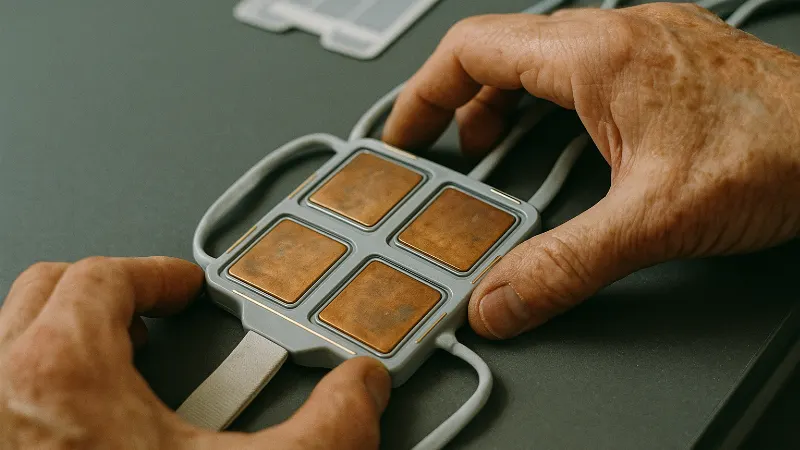
Transducer Arrays: These are adhesive pads containing ceramic disc electrodes that are placed directly on the skin of the torso. For mesothelioma, arrays are placed on the front, back, and sides of the chest, surrounding the tumor. The arrays must be replaced every 3-7 days, which requires shaving the area and cleaning the skin.
Field Generator: A portable device roughly the size of a small laptop bag that generates the electric fields. It connects to the transducer arrays via cables.
Battery System: Rechargeable batteries that allow patients to move freely. Each battery lasts approximately 4-6 hours, so patients typically carry spare batteries. A wall power supply is used at home for continuous treatment.
Daily Routine:
- Wake up: device has been running overnight (plugged into wall power)
- Morning: shower requires brief device removal (~30 minutes off time)
- Daytime: carry portable battery in a shoulder bag or backpack
- Activities: most normal activities are possible — walking, light exercise, driving, socializing
- Evening: return to wall power when home
- Sleep: device runs continuously while sleeping
Patient Compliance and Wear Time:
Research consistently shows that higher daily wear time correlates with better outcomes. The recommended minimum is 18 hours per day, but studies show patients who wear the device 22+ hours per day experience the greatest benefit. The STELLAR trial reported a mean daily compliance of approximately 70% of total time (about 17 hours/day).
Common Challenges and How Patients Manage Them
Skin irritation: The most common complaint. Patients learn to rotate array positions slightly between changes, use barrier creams, and work with Novocure's device support specialists to optimize placement.
Body image concerns: The arrays and wires are visible under clothing. Patients report that loose-fitting shirts and strategic clothing choices help. Many patients say that after the initial adjustment period, the cosmetic aspect becomes less of a concern relative to the treatment benefit.
Heat and discomfort: The arrays can generate mild warmth. In hot climates like Houston, patients may need to plan outdoor activities around cooler parts of the day.
Sleep adjustments: Some patients find it takes a week or two to adjust to sleeping with the arrays and cables. Using a pillow arrangement that accommodates the cable connections helps.
Social situations: Patients develop personal approaches to explaining the device to friends, colleagues, and strangers. Novocure provides patient support resources and connects new patients with experienced TTFields users.
Cost and Insurance Coverage
The financial reality of TTFields treatment is significant:
- List price: Approximately $21,000 per month — one of the most expensive cancer treatments available
- Medicare: Generally covered under the HDE approval, subject to prior authorization and local coverage determinations
- Private insurance: Coverage varies widely. Many insurers cover TTFields for approved indications, but prior authorization and appeals may be required
- Novocure patient assistance: The company offers financial assistance programs for patients who qualify, including copay assistance and free device programs for uninsured patients
- Duration: Treatment continues for as long as the patient benefits, potentially many months to years
Patients and families should work with their oncology team's financial counselor and Novocure's patient support team to understand coverage before starting treatment.
What This Means for Patients and Families
TTFields represents a genuinely new category of cancer treatment — the first novel mechanism of action to show survival benefit in mesothelioma in years. For patients and families evaluating treatment options, several points are important:
TTFields is an addition, not a replacement. It is used alongside standard chemotherapy, not instead of it. Patients receive the full benefit of chemotherapy plus the additional benefit of TTFields.
The commitment is real. Wearing a medical device 18+ hours per day is a significant lifestyle adjustment. Patients who are most successful with TTFields tend to be those who have strong family support, a positive attitude toward the treatment, and realistic expectations about the adjustment period.
Not everyone is a candidate. TTFields is indicated for unresectable malignant pleural mesothelioma. Patients with implanted electronic devices (pacemakers, defibrillators) or known sensitivity to adhesive materials may not be eligible. An oncologist experienced with TTFields can determine candidacy.
Ongoing research is expanding options. Clinical trials are investigating TTFields in combination with immunotherapy, in earlier-stage disease, and in other cancer types. The field is actively evolving.
Expert Legal Perspective
"When we work with mesothelioma patients exploring treatment options like TTFields, the cost question comes up immediately. At $21,000 per month, families are understandably worried about how to pay for it — even with insurance. This is one of the reasons pursuing compensation through trust fund claims and legal action is so important early in the process. The financial recovery from asbestos litigation can help cover treatment costs, out-of-pocket expenses, and the lost income that comes with a cancer diagnosis. We want patients to be able to choose the best available treatment without financial barriers."
>
— Paul Danziger, Managing Partner, Danziger & De Llano, LLP
Related Resources
- Mesothelioma Diagnosis & Treatment — Comprehensive guide to treatment options and stages
- Compensation & Legal Rights — How legal compensation can help cover treatment costs
- Mesothelioma Encyclopedic Guide — Detailed reference on mesothelioma types, prognosis, and research
- Patients & Families Resources — Support, caregiving, and coping resources
- Free Case Evaluation — No-cost legal consultation to understand your options
- Clinical Trials Guide — How to find and evaluate mesothelioma clinical trials

Sources
- Ceresoli, G.L., et al. "Tumor Treating Fields in Combination with Pemetrexed and Cisplatin or Carboplatin as First-Line Treatment for Unresectable Malignant Pleural Mesothelioma (STELLAR): A Multicentre, Single-Arm Phase 2 Trial." The Lancet Oncology, 20(12), 1702-1709 (2019).
- Novocure Ltd. "NovoTTF-100L System — Instructions for Use." novocure.com (2024).
- U.S. Food and Drug Administration. "NovoTTF-100L System — Humanitarian Device Exemption." fda.gov (2019).
- Vogelzang, N.J., et al. "Phase III Study of Pemetrexed in Combination with Cisplatin Versus Cisplatin Alone in Patients with Malignant Pleural Mesothelioma." Journal of Clinical Oncology, 21(14), 2636-2644 (2003).
- Kirson, E.D., et al. "Alternating Electric Fields Arrest Cell Proliferation in Animal Tumor Models and Human Brain Tumors." Proceedings of the National Academy of Sciences, 104(24), 10152-10157 (2007).
- Giladi, M., et al. "Mitotic Spindle Disruption by Alternating Electric Fields Leads to Improper Chromosome Segregation and Mitotic Catastrophe in Cancer Cells." Scientific Reports, 5, 18046 (2015).
- Centers for Medicare & Medicaid Services. "National Coverage Determination for Tumor Treating Fields." cms.gov (2023).
- National Comprehensive Cancer Network. "NCCN Clinical Practice Guidelines: Malignant Pleural Mesothelioma." nccn.org (2025).

Comments (2)
— Anna Jackson