

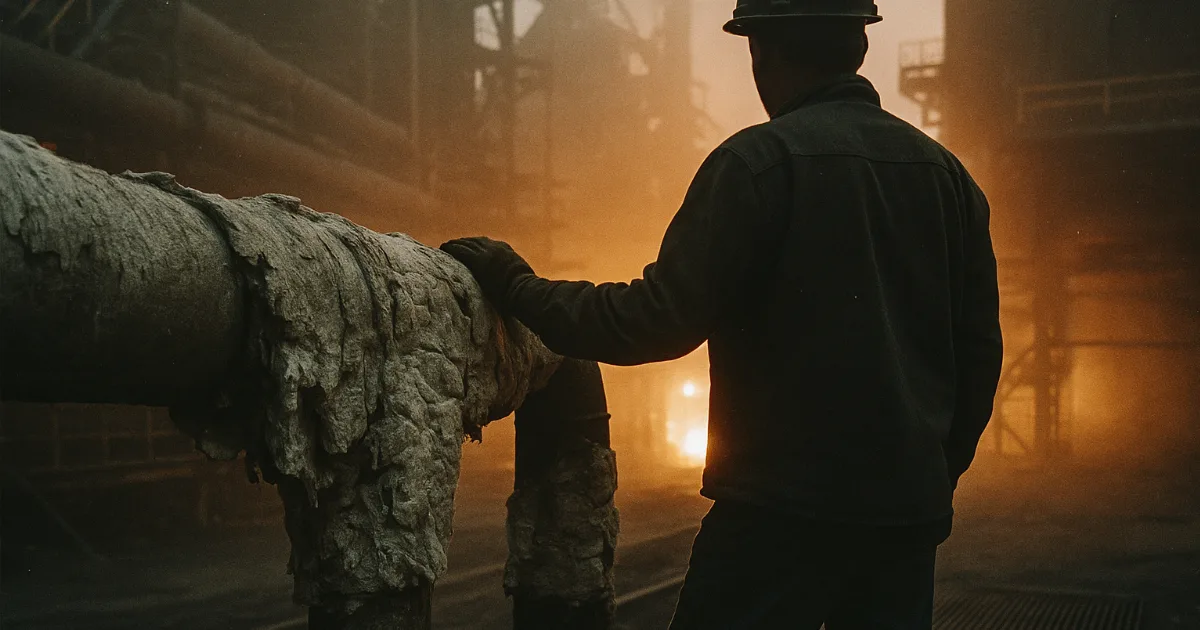
PITTSBURGH, PA — Walter Kowalski spent six years in the Army before coming home to western Pennsylvania and doing what three generations of his family had done before him: he went to work in the steel mills. For 24 years, he maintained furnaces, repaired pipe insulation, and breathed the air inside facilities that were saturated with asbestos dust. Nobody handed him a respirator. Nobody told him the white fibrous material packing the pipes around the blast furnaces was one of the most lethal substances ever used in industrial manufacturing.
Walter was 71 when a pulmonologist at the Pittsburgh VA Medical Center told him the persistent fluid around his left lung wasn't a lingering respiratory infection. It was pleural mesothelioma. His wife of 43 years sat in the corner of the examination room holding a paper cup of water she never drank. What I tell every veteran I work with in that moment is this: your service matters here, and so does that steel mill. Both exposures count, and both can open doors to compensation that most families don't know exist.
How Steel Mills Became One of America's Most Dangerous Asbestos Environments
The connection between steel mill work and mesothelioma is one of the most thoroughly documented occupational exposure relationships in American industrial history, yet it remains poorly understood by the workers and veterans who lived it. Steel mills used asbestos in virtually every high-heat application imaginable: furnace linings, pipe insulation, boiler coverings, refractory bricks, gaskets, protective clothing, and ceiling tiles throughout the plant. According to the Asbestos Nation resource database, integrated steel plants built before 1980 were among the highest-concentration asbestos environments in American industry, surpassed only by naval shipyards in some exposure analyses.
The physics of steel production made asbestos exposure almost unavoidable for workers in certain roles. Blast furnaces operate at temperatures exceeding 2,500 degrees Fahrenheit. The insulation required to maintain those temperatures and protect workers from radiant heat was, for most of the 20th century, made primarily from asbestos-containing materials. When that insulation aged, cracked, or was disturbed during maintenance, it released microscopic fibers into the air. Furnace operators, pipefitters, boilermakers, bricklayers, and maintenance crews worked in those conditions for decades.
The latency period for mesothelioma — the time between first asbestos exposure and diagnosis — typically ranges from 20 to 50 years, according to the National Cancer Institute. That biological clock is why steel workers who spent their prime working years in mills during the 1950s through 1980s are receiving diagnoses right now, in 2026. The men who built American steel are dying of the dust those mills produced.
For veterans who worked in steel mills either before or after military service, the exposure picture is frequently layered. A Marine who served from 1968 to 1972 and then spent 25 years at a Bethlehem Steel plant carried two separate asbestos exposure histories. The VA recognizes that both military and occupational exposures are relevant to a veteran's health, which creates specific legal and medical documentation strategies that can significantly affect compensation outcomes.
Why Veterans Are Disproportionately Represented Among Steel Mill Mesothelioma Cases
The overlap between military service and steel mill employment isn't coincidental. It reflects the economic geography of postwar America. Veterans returning from World War II, Korea, and Vietnam came home to industrial regions where steel mills were the dominant employer: Pittsburgh, Gary, Cleveland, Birmingham, Bethlehem, Youngstown, Detroit. These were cities built around the mills, and the mills actively recruited veterans, who were seen as disciplined, physically capable, and accustomed to demanding conditions.
According to the American Legion's veterans healthcare advocacy data, veterans have historically been overrepresented in heavy industrial occupations compared to the general population, a pattern that persisted through the 1980s. This means that a significant proportion of the steel mill workforce during the peak asbestos-use era was composed of men who had already experienced asbestos exposure during military service, particularly those who had served in the Navy or worked in military construction roles.
Navy veterans face a particularly acute double-exposure risk. Ships built before 1980 used asbestos throughout their construction, in engine rooms, boiler rooms, pipe systems, and sleeping quarters. A sailor who spent four years in an asbestos-saturated engine room and then 30 years in a steel mill carried an accumulated fiber burden that significantly elevates mesothelioma risk. Veterans who served during this period — roughly 1940 through 1975 — and subsequently worked in steel production represent one of the highest-risk populations for occupational asbestos disease.
The geographic concentration of these veterans also matters for legal purposes. States like Pennsylvania, Ohio, Indiana, and Illinois have specific statutes of limitations and asbestos litigation histories that affect how and when claims must be filed. Understanding those state-specific timelines is critical, because a claim filed one day after a state's deadline is typically barred entirely, regardless of how compelling the medical evidence is. Veterans navigating these systems need advocates who understand both the VA side and the civil litigation side of the equation. You can compare those two pathways at mesothelioma-lung-cancer.org/compare/va-vs-lawsuit/ before deciding how to proceed.
The Medical Reality: What Steel Mill Mesothelioma Looks Like in 2026
Consider a composite picture drawn from the cases I've seen over the past decade: a 68-year-old veteran, honorably discharged after four years of service, worked 27 years in a steel mill's blast furnace division. He presents to his VA primary care physician with shortness of breath and chest wall discomfort. Imaging reveals pleural thickening and fluid accumulation. A thoracoscopic biopsy confirms epithelioid pleural mesothelioma, the most common cell type and the one associated with the most favorable prognosis relative to other mesothelioma subtypes.
Pleural mesothelioma, which develops in the lining of the lungs, accounts for roughly 80 percent of all mesothelioma diagnoses, according to the National Cancer Institute's SEER database. The remaining cases include peritoneal mesothelioma, which affects the abdominal lining, and rarer forms involving the heart or testes. You can read a detailed explanation of peritoneal mesothelioma at mesothelioma-lung-cancer.org/encyclopedia/peritoneal-mesothelioma/ — it's relevant for steel workers who handled asbestos-containing materials in ways that created ingestion exposure pathways.
The standard treatment approach for pleural mesothelioma in 2026 involves a combination of strategies depending on disease stage and the patient's overall health. The VA's National Oncology Program has expanded access to immunotherapy combinations, including nivolumab plus ipilimumab, following FDA approval of that regimen for unresectable pleural mesothelioma. For veterans interested in understanding how immunotherapy works in this context, mesothelioma-lung-cancer.org/encyclopedia/immunotherapy-mesothelioma/ provides a thorough explanation of the mechanisms and clinical evidence.
Surgical options, including extrapleural pneumonectomy and pleurectomy with decortication, remain available at specialized VA medical centers for patients who meet candidacy criteria. The VA's National Oncology Program includes mesothelioma as a covered condition under its specialized cancer care protocols, meaning veterans diagnosed at VA facilities can access multidisciplinary tumor boards and specialist consultations without the out-of-pocket costs that would accompany equivalent care in the private sector.
For a comprehensive overview of current diagnosis and treatment pathways, mesothelioma-lung-cancer.org/diagnosis-treatment/ walks through the clinical decision tree from initial imaging to treatment selection in language that patients and families can actually use.
!The Medical Reality: What Steel Mill Mesothelioma Looks Like in for mesothelioma veteran cases
Navigating VA Benefits When Your Exposure Was Mostly Civilian
Here's where many steel mill veterans get confused, and where I see families leave significant money on the table. Veterans sometimes assume that because most of their asbestos exposure happened in the mill rather than during military service, they don't qualify for VA disability benefits. That assumption is wrong, and it's costly.
The VA recognizes that asbestos-related diseases are presumptively service-connected for veterans who served in occupational specialties with documented asbestos exposure during their service period. But even veterans whose primary exposure was occupational, meaning post-service, can establish service connection if they can demonstrate any asbestos exposure during their military years. A Navy veteran who worked around asbestos pipe lagging during service and then worked in a steel mill for 30 years has a legitimate pathway to VA disability compensation based on the military exposure component, even if the mill exposure was quantitatively larger.
According to VA disability claims guidance, a veteran seeking service connection for mesothelioma must establish three things: a current diagnosis, an in-service event or exposure, and a medical nexus linking the two. For mesothelioma specifically, the nexus is almost always straightforward once exposure during service is established, because the disease has no known cause other than asbestos exposure. The VA's own guidelines acknowledge that mesothelioma is essentially pathognomonic for asbestos exposure, meaning the disease itself is strong evidence of the exposure.
The practical steps for filing a VA claim are documented at mesothelioma-lung-cancer.org/guides/apply-va-disability-mesothelioma/, and you can check your preliminary eligibility using the VA benefits eligibility tool at mesothelioma-lung-cancer.org/tools/va-benefits-eligibility/. Don't try to navigate the claims process without understanding what documentation you need before you file, because an incomplete initial claim can delay benefits by months.
Veterans who served at Camp Lejeune between 1953 and 1987 face an additional layer of exposure considerations. The VA's Camp Lejeune program covers toxic water exposure at that base, and some veterans with dual Camp Lejeune and steel mill histories have successfully pursued both exposure pathways in their claims. The VA's Camp Lejeune past exposures documentation provides guidance on what conditions are covered under that specific program.
For a broader look at all available veterans benefits and how they interact with civil litigation options, mesothelioma-lung-cancer.org/answers/veterans/ is a good starting point.

The Civil Compensation Landscape: Asbestos Trust Funds and Steel Industry Litigation
VA benefits and civil compensation are not mutually exclusive. This is one of the most important things I communicate to every veteran family I work with. Receiving VA disability benefits does not prevent a veteran or surviving family member from also pursuing compensation through asbestos bankruptcy trust funds or civil litigation against the manufacturers of asbestos-containing products used in the steel mill.
The asbestos bankruptcy trust fund system holds more than $30 billion in reserves specifically to compensate workers and veterans harmed by asbestos-containing products, according to the RAND Corporation's analysis of the trust fund landscape. These funds were established when major asbestos product manufacturers filed for bankruptcy under the weight of litigation, and they continue to pay claims to this day. Steel mill workers have historically been among the most successful trust fund claimants because the specific products used in steel production — pipe insulation, refractory materials, boiler gaskets — were made by identifiable manufacturers who subsequently established trusts.
Companies like Johns-Manville, Owens Corning, Armstrong World Industries, and Combustion Engineering all manufactured asbestos products that were widely used in steel mills and all subsequently established bankruptcy trusts. A steel mill worker who can document exposure to specific products made by those manufacturers can file claims against multiple trusts simultaneously. Settlement values from individual trust claims typically range from tens of thousands to several hundred thousand dollars, and a veteran with documented exposure to multiple manufacturers' products might file claims against five, ten, or more trusts.
Civil litigation against companies that were not covered by bankruptcy protection remains a separate option. Some steel companies themselves, as well as distributors and contractors who supplied asbestos products to mills, remain solvent defendants in asbestos litigation. Verdicts and settlements in these cases have ranged widely, but mesothelioma cases involving documented occupational exposure and clear product identification have historically produced significant outcomes.
For a directory of active asbestos trust funds and how to determine which ones apply to your specific exposure history, mesothelioma-lung-cancer.org/directory/trust-funds/ provides a searchable resource. The compensation overview at mesothelioma-lung-cancer.org explains the full range of financial options available to patients and surviving family members.
What Surviving Family Members Need to Know
Walter Kowalski died 14 months after his diagnosis. His wife, Margaret, didn't know that her husband's death entitled her to pursue both VA dependency and indemnity compensation and civil wrongful death claims against the manufacturers of the asbestos products that killed him. She found out through a veterans service organization representative who visited the Pittsburgh VA's oncology unit.
Surviving spouses and dependent children of veterans who die from mesothelioma may qualify for VA Dependency and Indemnity Compensation, a monthly benefit that is separate from and in addition to any civil settlement or trust fund recovery. The VFW's advocacy program maintains resources for surviving family members navigating these claims, and the American Legion similarly provides claims assistance through its service officer network.
The statute of limitations for wrongful death claims varies by state, but most states allow one to three years from the date of death to file. This deadline is not flexible. Families who wait too long lose their legal rights permanently, regardless of how clear the liability might be. What I tell every veteran I work with, and every family member who calls me after a loss, is that the legal clock starts the moment the death certificate is signed. Understanding that timeline is not optional.
For family members dealing with the immediate aftermath of a mesothelioma diagnosis, the CureMeso Foundation's patient support services provide practical assistance including financial navigation, clinical trial referrals, and caregiver support resources. These services are available regardless of whether a patient is actively pursuing legal claims.
If the veteran also had lung cancer as a component of their asbestos-related disease, additional compensation pathways may apply. Asbestos exposure is a recognized cause of lung cancer independent of mesothelioma, and workers with documented heavy asbestos exposure who develop lung cancer may have claims through both the trust fund system and civil litigation.
The Documentation Challenge: Building a Case Decades Later
One of the hardest practical challenges in steel mill mesothelioma cases is reconstruction. A worker who spent 25 years in a mill that closed in 1995 may have limited access to employment records, product purchase records, or co-worker testimony. The companies that manufactured the asbestos products used in that mill may have gone through bankruptcy, restructuring, or dissolution. Building a coherent exposure history requires investigative work that most families can't do alone.
This is where experienced mesothelioma attorneys earn their value. Firms that specialize in asbestos litigation maintain proprietary databases of industrial site records, product distribution histories, and co-worker depositions from previous cases. They can often reconstruct an exposure history for a specific mill, in a specific decade, using records from previous litigation involving that facility. A Pittsburgh mill worker's case might draw on deposition testimony from a 1987 case involving the same plant, testimony that documents which specific asbestos products were used and how workers were exposed.
For veterans, military service records add another documentation layer. DD-214 forms, military occupational specialty codes, and ship assignment records can establish the military exposure component of a dual-exposure case. The National Personnel Records Center in St. Louis maintains these records, though retrieval can take weeks or months. Starting that process early is critical, particularly if you're also filing a VA disability claim that requires the same documentation.
The VA itself has a formal process for requesting military personnel records to support disability claims, described in the VA's how-to-file guidance. Veterans service organizations including the VFW and the American Legion can assist with record requests at no charge to the veteran.
!Steel Mill Veterans and Mesothelioma: The Asbestos Exposure Nobody Warned Them About

Frequently Asked Questions
Q: Do steel mill workers qualify for VA benefits if their asbestos exposure was primarily at the mill rather than during military service?
Veterans with any documented asbestos exposure during military service can pursue VA disability claims for mesothelioma, even if their heavier exposure occurred post-service at a steel mill. The VA requires establishing a current diagnosis, an in-service exposure event, and a medical nexus. For mesothelioma, the nexus is typically straightforward because asbestos is the only known cause. Veterans should file claims and let the VA adjudicate the exposure question rather than self-disqualifying. See the VA's disability claims guidance for specifics.
Q: Can a steel mill veteran collect both VA disability benefits and civil lawsuit compensation?
Yes. VA disability benefits and civil compensation through asbestos trust funds or litigation are legally separate and can be pursued simultaneously. Receiving VA benefits does not reduce or eliminate your right to civil compensation, and civil settlements do not typically affect VA benefit eligibility. Many veterans and surviving family members successfully pursue both pathways. Consulting with a mesothelioma attorney who has VA experience is the most effective way to coordinate both processes without inadvertently affecting either claim.
Q: What is the average payout from asbestos trust funds for steel mill mesothelioma cases?
Trust fund payouts vary significantly depending on which trusts apply to your specific exposure history, the trust's payment percentage at the time of filing, and the documentation you can provide. Individual trust claims for mesothelioma typically range from tens of thousands to several hundred thousand dollars. Because steel mills used products from multiple manufacturers, many claimants file against five or more trusts, making the aggregate recovery substantially higher than any single claim. An experienced mesothelioma attorney can identify which trusts apply to your case.
Q: How long does a mesothelioma diagnosis give a veteran to file VA and civil claims?
For VA disability claims, there is no filing deadline after a mesothelioma diagnosis, but earlier filing means earlier benefits. For civil claims, statutes of limitations vary by state, typically ranging from one to three years from the date of diagnosis or the date you knew or should have known the diagnosis was asbestos-related. Some states have discovery rules that can extend this window. Wrongful death claims have separate deadlines that run from the date of death. Do not delay consulting an attorney to determine your specific deadlines.
Q: Which branches of military service had the highest asbestos exposure in steel-relevant occupations?
Navy veterans face the highest documented asbestos exposure risk due to the pervasive use of asbestos in ship construction, particularly in engine rooms, boiler rooms, and pipe systems. Army and Marine Corps veterans who worked in construction, maintenance, or engineering specialties also had significant exposure. Air Force veterans in aircraft maintenance roles encountered asbestos in brake systems and insulation. Veterans who served in any branch in roles involving heat systems, pipe work, or building maintenance during service years before 1980 should assume potential exposure and discuss it with a VA physician.
Q: What medical evidence does the VA require to approve a mesothelioma disability claim?
The VA requires a confirmed mesothelioma diagnosis from a qualified pathologist, documentation of asbestos exposure during military service, and a nexus opinion linking the exposure to the disease. For mesothelioma specifically, the nexus requirement is typically satisfied by the diagnosis itself, since asbestos is the sole recognized cause. The VA may request an independent medical examination, but many claims are approved on submitted medical records alone. Working with a VA-accredited claims agent or veterans service organization representative can significantly improve claim outcomes.
Q: Are there clinical trials available to steel mill veterans with mesothelioma through the VA?
Yes. The VA's National Oncology Program participates in cooperative research agreements that provide veterans with access to clinical trials, including mesothelioma-specific studies. VA medical centers affiliated with academic medical centers often have direct clinical trial access. Veterans can also access trials outside the VA system through the National Cancer Institute's trial matching services, and some VA facilities will coordinate care with outside trial sites. Discussing clinical trial eligibility with a VA oncologist at the time of diagnosis is strongly recommended.
Q: What should surviving family members do immediately after a steel mill veteran dies from mesothelioma?
Surviving spouses and dependents should take three immediate steps: preserve all medical records and the death certificate, contact the VA about Dependency and Indemnity Compensation benefits, and consult a mesothelioma attorney about wrongful death claims before state statutes of limitations expire. Most states allow one to three years from the date of death to file wrongful death claims. Veterans service organizations including the VFW and American Legion provide free assistance with VA survivor benefit claims. Do not wait to begin this process.
This article provides general information about VA benefits. Eligibility depends on individual service history and medical diagnosis.