

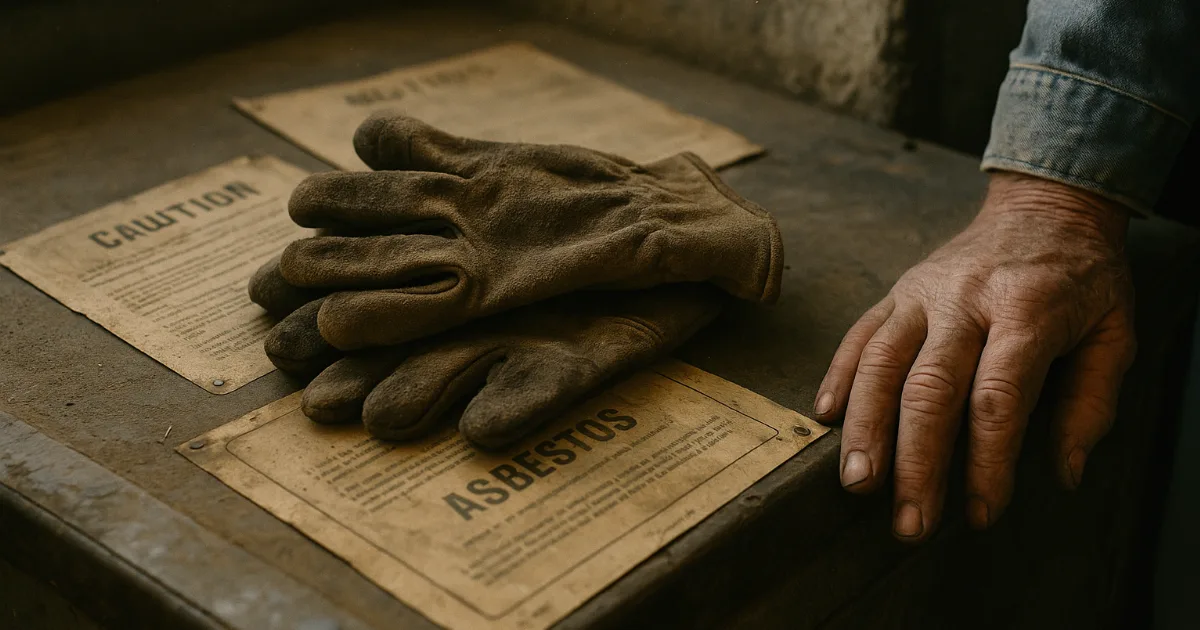
SALT LAKE CITY, UT — The letter from the oncologist confirmed what Dale Hutchinson's family had feared since October. The retired copper smelter worker from Magna, Utah, had spent 28 years at a facility where asbestos-wrapped pipes and insulation materials were as common as the smelting furnaces themselves. His diagnosis: pleural mesothelioma, stage III. His daughter, who asked that the family's last name be changed for privacy, remembers sitting in the parking lot of the hospital and googling "what happens next." She found a mountain of information about treatment, but almost nothing about what legal options existed specifically for families in Utah.
That gap is more dangerous than most people realize. Utah has its own statute of limitations rules, its own court procedures, and its own history of asbestos-contaminated worksites that shaped the exposure patterns of an entire generation of workers. And the clock on filing a claim starts ticking from the date of diagnosis, not the date of exposure. For a family already overwhelmed by a terminal diagnosis, missing that window doesn't just mean losing money. It can mean losing everything.
This article is the comprehensive guide that Dale's daughter couldn't find. It covers the legal rights of Utah mesothelioma patients and their families, the specific statutes that govern those rights, how trust fund claims work alongside civil lawsuits, what a skilled Utah mesothelioma lawyer actually does for a family, and why the legal landscape in 2026 still offers meaningful paths to compensation for people whose asbestos exposure happened decades ago.
Utah's Asbestos Legacy: The Worksites That Defined a Generation
Utah doesn't make the national headlines the way New Jersey or Louisiana do when asbestos litigation is discussed, but the state carries a substantial industrial history that exposed tens of thousands of workers to deadly asbestos fibers over the course of the 20th century. The copper, steel, and mining industries that built Utah's economy were also industries that depended heavily on asbestos-containing materials for insulation, fireproofing, and equipment protection.
The Kennecott Copper Mine and Smelter complex in Bingham Canyon and Magna is among the most frequently cited exposure sites in Utah mesothelioma cases. Workers there were exposed to asbestos in pipe insulation, boiler coverings, brake linings, and gaskets throughout the mid-20th century. According to litigation data compiled by legal research firms tracking asbestos cases, the Kennecott complex has appeared in mesothelioma lawsuits filed in Utah federal and state courts for decades.
Beyond mining, Utah's construction trades, military installations including Hill Air Force Base, and the Geneva Steel plant in Orem (which operated from 1944 to 2001) created additional exposure populations that are still generating diagnoses today. Asbestos exposure in these settings was rarely a single dramatic event. It was chronic, cumulative, and invisible. Workers breathed in fibers daily for years, and the disease those fibers cause typically doesn't appear until 20 to 50 years after the initial exposure.
That latency period is what makes mesothelioma legally unique. A worker exposed at Geneva Steel in 1975 may not receive a diagnosis until 2025 or 2026. The companies responsible for that exposure may have gone bankrupt, merged, or dissolved in the intervening decades. Identifying them, proving their liability, and recovering compensation requires legal expertise that goes well beyond general personal injury practice.
Understanding Utah's Statute of Limitations for Mesothelioma Claims
Imagine learning that the two-year window to file your lawsuit started the day you were diagnosed, and that you've already spent six months simply trying to understand your treatment options. That's the reality for most Utah mesothelioma patients, and it's the first thing any competent Utah mesothelioma lawyer will address.
Under Utah law, mesothelioma victims generally have two years from the date of diagnosis, or from the date they reasonably should have known the disease was linked to asbestos exposure, to file a personal injury lawsuit. For wrongful death claims filed by surviving family members, the two-year clock typically begins at the date of the patient's death. These deadlines are firm. Courts rarely grant exceptions, and missing the window almost always means permanently forfeiting the right to sue.
The discovery rule is critically important here. Utah, like most states, applies a discovery rule to latent disease cases, meaning the statute of limitations begins running not from the date of the asbestos exposure, but from the date the plaintiff discovered, or reasonably should have discovered, that the disease was caused by asbestos. This rule exists precisely because of mesothelioma's long latency period. It would be fundamentally unjust to bar a lawsuit filed in 2026 simply because the exposure occurred in 1972.
You can check Utah's specific statute of limitations parameters using the statute of limitations tool at Mesothelioma-Lung-Cancer.org, which allows families to quickly understand their filing window based on diagnosis date and state of residence.
What many families don't realize is that the statute of limitations for trust fund claims operates differently and often more generously than the deadline for civil lawsuits. Many asbestos bankruptcy trusts allow claims to be filed years after a civil lawsuit would be time-barred. A knowledgeable attorney can often pursue trust fund claims even when the window for direct litigation has closed.
What a Utah Mesothelioma Lawyer Actually Does
The phrase "mesothelioma lawyer" gets used loosely, but in my experience representing mesothelioma families, the difference between a general personal injury attorney and a specialist in asbestos litigation is the difference between someone who understands the terrain and someone who is learning it at your expense.
A skilled Utah mesothelioma attorney performs functions that are genuinely specialized. They maintain databases of asbestos-containing products, manufacturers, and distributors that were used at specific Utah worksites during specific decades. They know which of those companies filed for bankruptcy and which trusts were established to pay claims. They understand which product lines were at issue in prior litigation, which expert witnesses are most effective in Utah courts, and how Utah juries have historically responded to asbestos cases.
The initial investigation phase alone can involve reviewing decades-old employment records, union records, Social Security earnings histories, and product invoices. Attorneys often work with industrial hygienists who can reconstruct historical asbestos exposure levels at specific worksites. This forensic work is essential because defendants in mesothelioma cases almost universally dispute both the fact of exposure and the specific products involved.
Once the exposure history is documented, the attorney files claims against responsible parties. This typically involves both direct litigation against solvent defendants and trust fund claims against companies that went bankrupt. According to RAND Corporation research on asbestos bankruptcy trusts, more than 60 trusts have been established to compensate asbestos victims, with combined assets that have exceeded $30 billion. Identifying which trusts apply to a specific client's exposure history, and filing those claims correctly and on time, is a core function of specialized asbestos legal representation.
For families navigating this process, the compensation overview at Mesothelioma-Lung-Cancer.org provides a useful starting framework for understanding the different channels through which financial recovery can occur.
!What a Utah Mesothelioma Lawyer Actually Does for mesothelioma legal cases
The Dual-Track Strategy: Lawsuits and Trust Fund Claims
One of the most consequential decisions a Utah mesothelioma attorney makes on behalf of a client is how to structure the dual-track approach: pursuing civil litigation against solvent defendants simultaneously with trust fund claims against bankrupt companies.
These two paths are not mutually exclusive, and in most complex mesothelioma cases, they're pursued in parallel. But they require careful coordination. Many states, including Utah, require plaintiffs to disclose trust fund claims during civil litigation, and some defendants will argue that trust fund recoveries should offset jury awards. An experienced attorney structures the sequence and timing of claims to maximize total recovery while complying with disclosure requirements.
The lawsuit versus trust fund claim comparison tool at Mesothelioma-Lung-Cancer.org walks families through the key differences between these two paths, including timelines, average payouts, and the evidentiary requirements for each.
Civil lawsuits against solvent defendants can yield substantially larger individual recoveries than trust fund claims, but they take longer and carry more uncertainty. Trust fund claims are typically more predictable: each trust has established payment percentages and review criteria, and claims are processed administratively rather than litigated in court. For a patient with a limited prognosis, the speed and certainty of trust fund claims can be as important as the dollar amount.
According to legal coverage tracked by Law360 and Reuters, mesothelioma verdicts in recent years have ranged from the hundreds of thousands of dollars to multi-million dollar awards, with settlements frequently falling in the $1 million to $2.4 million range for cases involving significant exposure history and clear manufacturer liability. Trust fund payments vary by trust, with some established trusts paying claims at rates that reflect the severity of the disease and the strength of the exposure documentation.
"In my experience representing mesothelioma families, the clients who recover the most are those who pursue every available avenue simultaneously, not sequentially," said Paul Danziger, a board-certified personal injury trial attorney who has handled asbestos cases across multiple jurisdictions. "Waiting to see how the lawsuit plays out before filing trust claims costs families both time and money they can't afford to lose."

Utah Verdicts and Settlements: What the Courts Have Shown
Utah's civil court system has seen its share of mesothelioma litigation, though the state's smaller industrial population means its docket is less voluminous than states like California, New York, or Texas. What the courts have consistently recognized in Utah asbestos cases, as in other jurisdictions, is that manufacturers who knew about the dangers of asbestos and failed to warn workers bear substantial liability for the resulting harm.
The legal theories most commonly pursued in Utah mesothelioma cases include strict products liability (arguing that asbestos-containing products were defective because they lacked adequate warnings), negligence (arguing that manufacturers and employers failed to take reasonable precautions), and occasionally fraud or conspiracy claims where evidence shows defendants actively concealed known dangers.
Utah follows the modified comparative fault rule, which means a plaintiff can recover damages even if they were partially at fault for their own exposure, as long as their fault does not exceed 50 percent. In mesothelioma cases, comparative fault arguments by defendants are relatively uncommon given the nature of occupational asbestos exposure, but they do arise in cases where plaintiffs also smoked cigarettes or worked in multiple high-exposure environments.
Damages in Utah mesothelioma cases can include medical expenses (past and future), lost wages and earning capacity, pain and suffering, loss of consortium for spouses, and in wrongful death cases, funeral expenses and the economic value of the deceased's contributions to the family. Punitive damages, which are designed to punish particularly egregious conduct, are also available under Utah law in cases where defendants acted with malice, fraud, or oppression.
According to litigation coverage from Bloomberg and Reuters tracking asbestos verdicts nationally, the trend in recent years has been toward larger individual verdicts, particularly in cases involving defendants with documented internal knowledge of asbestos hazards. Internal corporate documents showing that manufacturers knew about mesothelioma risks decades before they warned workers have been devastating to defense arguments in courtrooms across the country.
The Veterans Dimension: Hill Air Force Base and Military Exposure
A significant subset of Utah mesothelioma cases involves military veterans, and this population faces a uniquely complex legal and benefits landscape. Hill Air Force Base, located in Ogden, has been an active military installation since 1940, and the aircraft maintenance, construction, and infrastructure work performed there exposed generations of military personnel and civilian contractors to asbestos.
Veterans who were exposed to asbestos during military service and have been diagnosed with mesothelioma may be entitled to VA disability compensation in addition to, not instead of, civil litigation recovery. The VA and civil courts are separate systems, and receiving VA benefits does not preclude a veteran from also pursuing a lawsuit or trust fund claims against the manufacturers of asbestos products used during their service.
For Utah veterans navigating this dual system, the VA benefits eligibility tool at Mesothelioma-Lung-Cancer.org can help clarify what VA compensation may be available and how it interacts with civil claims.
What the courts have consistently recognized is that veterans deserve access to both systems. A veteran's right to sue asbestos product manufacturers is not diminished by the fact that the exposure occurred during military service. The government itself typically has sovereign immunity from asbestos lawsuits, but the private companies that manufactured and sold asbestos-containing products to the military do not. These manufacturers knew their products would be used in military settings, and they had the same duty to warn that they had in any other context.
In my experience representing mesothelioma families, veterans are among the most underserved populations in asbestos litigation. Many assume that because their exposure happened in the service, they have no civil legal recourse. That assumption costs families hundreds of thousands, and in some cases millions, of dollars in legitimate compensation.
Finding the Right Utah Mesothelioma Attorney
Salt Lake City's legal market includes several attorneys and firms that handle asbestos cases, but the quality and depth of specialization varies considerably. When a family is evaluating legal representation after a mesothelioma diagnosis, the questions they ask matter as much as the answers they receive.
A qualified Utah mesothelioma attorney should be able to articulate specific experience with asbestos cases, not just general personal injury work. They should be able to name the trusts they've filed claims with, describe their approach to building an exposure history, and explain how they've handled cases involving Utah-specific worksites. They should also be transparent about their fee structure. Virtually all reputable mesothelioma attorneys work on a contingency basis, meaning they receive a percentage of any recovery and charge nothing upfront. If an attorney asks for upfront fees in a mesothelioma case, that's a serious red flag.
Families should also understand that they are not required to hire a Utah-based attorney. Mesothelioma litigation frequently involves multiple jurisdictions, and many of the most experienced asbestos trial firms are based in states like Texas, California, or New York. These firms regularly handle Utah cases and are admitted to practice in Utah courts or work with local co-counsel. What matters most is the attorney's depth of experience in asbestos litigation, not their zip code.
The doctor directory at Mesothelioma-Lung-Cancer.org can also help Utah families identify mesothelioma specialists in the region, which is relevant to legal cases because having documentation from a recognized mesothelioma specialist strengthens both the medical and legal components of a claim.
The Asbestos Trust Fund System: How It Works for Utah Families
The asbestos trust fund system is one of the most consequential and least understood aspects of mesothelioma compensation. When major asbestos manufacturers and distributors faced overwhelming liability from mesothelioma lawsuits in the 1980s and 1990s, many filed for bankruptcy protection. As a condition of that bankruptcy, they were required to establish trusts with sufficient funding to pay current and future asbestos claims.
According to RAND Corporation research on asbestos bankruptcy trusts, these structures were designed to balance the interests of current claimants with the rights of future claimants who hadn't yet been diagnosed. Each trust operates under a Trust Distribution Procedure (TDP) that specifies which diseases qualify for compensation, what documentation is required, and what payment percentages apply.
For a Utah worker who was exposed to asbestos products from multiple manufacturers over a career spanning decades, there may be a dozen or more trusts that are potentially applicable. The Manville Personal Injury Settlement Trust, established after Johns-Manville's bankruptcy in 1982, is the largest and most well-known. But trusts established by companies like Armstrong World Industries, Owens Corning, W.R. Grace, and dozens of others may also apply depending on the specific products involved in a worker's exposure history.
Filing claims with multiple trusts simultaneously is standard practice in sophisticated mesothelioma cases. According to legal coverage from Law360, claimants with strong exposure documentation and a confirmed mesothelioma diagnosis can sometimes recover from six, eight, or even more trusts in a single case. The cumulative effect of multiple trust fund recoveries, combined with civil litigation settlements, is what produces the total compensation figures that are sometimes cited in mesothelioma case discussions.
The answers to compensation questions section at Mesothelioma-Lung-Cancer.org addresses many of the most common questions families have about trust fund claims, including how long they take, what documentation is needed, and how they interact with civil lawsuits.
How Mesothelioma Cases Are Actually Built
There's a version of mesothelioma litigation that gets discussed in broad strokes, and then there's the actual work. Understanding what goes into building a mesothelioma case helps families appreciate both the value of specialized legal representation and the importance of acting quickly to preserve evidence.
The foundational document in any mesothelioma case is the exposure history. This is a detailed, chronological account of every worksite where the plaintiff was employed, every asbestos-containing product they worked with or around, and the nature and duration of that exposure. Building this document typically involves extensive client interviews, review of employment and union records, co-worker testimony, and consultation with industrial hygienists who can testify about historical asbestos use at specific facilities.
For Utah workers, this often means documenting exposure at sites that may no longer exist, for companies that may have dissolved or been acquired multiple times. The Geneva Steel plant in Orem, for example, operated under multiple ownership structures before its final closure in 2001. Tracing the corporate lineage of responsible parties, and identifying which successor entities or insurance carriers bear liability, is a significant undertaking.
Medical documentation is equally critical. A mesothelioma diagnosis must be confirmed by pathology, and ideally reviewed by a specialist at a recognized cancer center. For Utah patients, the Huntsman Cancer Institute at the University of Utah in Salt Lake City is the state's most prominent cancer treatment and research facility, and its specialists frequently provide the medical documentation that supports litigation.
Once the exposure history and medical documentation are assembled, the attorney identifies all potentially liable defendants, both solvent companies that can be sued in court and bankrupt companies whose trusts can receive claims. The legal theories are then applied to each defendant based on their specific role in the exposure, whether they manufactured a product, distributed it, specified its use, or employed the worker without adequate protective measures.
"The legal landscape for asbestos victims is more navigable than many families realize, but only if you have someone who knows where all the doors are," Danziger said. "The trust system, the civil courts, the VA, the workers' compensation system in some cases — these are all potential sources of recovery that require different strategies and different documentation."
What Compensation Looks Like in Real Terms
The numbers that appear in mesothelioma compensation discussions can seem abstract until they're connected to what they actually represent for a family. Medical treatment for mesothelioma, including surgery, chemotherapy, immunotherapy, and radiation, can cost hundreds of thousands of dollars even with insurance. The financial strain of lost income, travel for treatment, and home care can devastate a family's savings in months.
Compensation in mesothelioma cases is designed to address several categories of loss. Economic damages cover quantifiable losses: medical bills, lost wages, the cost of future care, and in wrongful death cases, the economic value of the deceased's contributions to the household. Non-economic damages cover the harder-to-quantify losses: pain and suffering, loss of enjoyment of life, emotional distress, and loss of consortium.
According to data tracked by Reuters and Bloomberg covering asbestos litigation trends, mesothelioma settlements in cases with strong liability evidence and documented significant exposure have historically ranged from approximately $1 million to $2.4 million. Trial verdicts, which are less common because most cases settle, can reach significantly higher figures, particularly when punitive damages are awarded.
For trust fund claims specifically, individual trust payments vary considerably. Some trusts pay claims at a small percentage of their scheduled value due to the volume of claims relative to available assets. Others, with more robust funding relative to their claim population, pay at higher rates. A comprehensive case involving multiple trust claims and civil litigation can produce total recoveries that are substantially higher than any single source would provide.
For families trying to understand what their specific situation might look like, the compensation overview provides context about the factors that influence recovery amounts, including disease type, exposure history, defendant financial condition, and jurisdiction.
Pleural Mesothelioma: The Most Common Form and Its Legal Implications
Approximately 75 to 80 percent of all mesothelioma diagnoses involve the pleura, the lining of the lungs. Pleural mesothelioma is the form most commonly associated with occupational asbestos exposure, and it's the form that appears most frequently in Utah litigation given the state's industrial exposure history.
The legal implications of a pleural mesothelioma diagnosis are significant in several ways. First, the disease's clear association with asbestos exposure makes causation arguments relatively straightforward compared to other asbestos-related diseases like lung cancer, where smoking history can complicate liability arguments. Second, the severity and prognosis of pleural mesothelioma typically support substantial non-economic damage claims. Third, the specific fiber types and exposure pathways associated with pleural mesothelioma have been extensively documented in scientific literature, providing robust expert testimony support.
For peritoneal mesothelioma, which affects the lining of the abdomen and accounts for roughly 15 to 20 percent of cases, the legal framework is similar but the medical documentation and expert testimony requirements may differ slightly. The mesothelioma encyclopedia at Mesothelioma-Lung-Cancer.org provides detailed information about the different forms of the disease and their relationship to asbestos exposure.
The Role of Expedited Proceedings for Seriously Ill Patients
One of the most important but least publicized aspects of mesothelioma litigation is the availability of expedited proceedings for terminally ill patients. Most jurisdictions, including Utah, recognize that a mesothelioma patient with a limited life expectancy cannot wait three to five years for a case to work its way through the normal litigation schedule.
Utah courts, like courts in most states, allow mesothelioma cases to be placed on an expedited track when the plaintiff's medical condition warrants it. These preference motions, as they're sometimes called, can accelerate a case from filing to trial in months rather than years. The practical effect is that a patient who is still alive and able to testify can participate in their own trial, which is often a powerful factor in jury deliberations.
According to litigation coverage from the National Law Review, courts have increasingly recognized the importance of expedited proceedings in terminal illness cases, and defendants in asbestos cases have generally accepted this framework as a feature of the litigation landscape. The result is that many mesothelioma cases resolve in settlement before trial once the expedited track is established, because defendants recognize that a sympathetic plaintiff who is visibly ill and able to testify presents a formidable challenge to a jury.
For families evaluating legal options, the timing of when to file is therefore a nuanced calculation. Filing promptly after diagnosis maximizes the options available, including the ability to pursue expedited proceedings if the patient's condition warrants it. Waiting, even for a few months, can close off options that would otherwise be available.
What Families Should Do Immediately After a Diagnosis
The weeks immediately following a mesothelioma diagnosis are among the most disorienting of a family's life. Treatment decisions, financial pressures, and emotional devastation all compete for attention simultaneously. But the legal steps taken, or not taken, in those early weeks can have permanent consequences.
The first priority is confirming the diagnosis with a specialist. A mesothelioma diagnosis from a general pulmonologist or even an oncologist who doesn't specialize in the disease should be confirmed by a pathologist with specific experience in mesothelioma. This matters both medically and legally. Misdiagnoses occur, and the legal case depends on a pathologically confirmed mesothelioma diagnosis.
The second priority is contacting a qualified mesothelioma attorney as soon as possible after diagnosis. Not to sign anything or commit to anything, but to understand the timeline and options. A reputable attorney will provide a free consultation, explain the statute of limitations as it applies to your specific situation, and give you an honest assessment of whether a viable claim exists. There is no cost and no obligation to this initial conversation, and the information it provides can shape every subsequent decision.
The third priority is beginning to document the exposure history while memory is fresh and while the patient can still participate in that process. Employment records, union cards, old photographs, co-worker contact information, pay stubs, and any product names or brands the patient remembers using or working around are all potentially valuable. This documentation effort can proceed in parallel with medical treatment and doesn't require any legal commitment.
Families can also use the answers to compensation questions resource to begin understanding what the financial recovery process typically looks like before they've even spoken to an attorney.

Looking Ahead: The Legal Landscape for Utah Asbestos Victims in 2026
The asbestos litigation landscape in 2026 continues to evolve in ways that are both favorable and challenging for mesothelioma victims and their families. On the favorable side, the scientific consensus on asbestos causation is stronger than ever, making it increasingly difficult for defendants to challenge the basic causal link between asbestos exposure and mesothelioma. Courts have also become more sophisticated about the trust fund system and its interaction with civil litigation, reducing some of the procedural complexity that plagued cases in earlier decades.
On the challenging side, the pool of solvent defendants with direct liability for asbestos exposure has continued to shrink as companies have gone bankrupt, merged, or otherwise restructured. This means that trust fund claims are playing an increasingly prominent role relative to direct civil litigation in many cases. The trust funds themselves are also managing their assets carefully, with some trusts operating at reduced payment percentages to ensure they can satisfy future claims from patients who haven't yet been diagnosed.
According to RAND Corporation research on asbestos bankruptcy trusts, the long-term sustainability of the trust system depends on careful actuarial management of assets against projected future claims. For current claimants, this means that acting promptly to file trust claims while trusts are adequately funded is a practical financial consideration, not just a legal deadline issue.
The legal landscape for asbestos victims in Utah also reflects national trends in asbestos litigation reform. Several states have enacted or considered legislation that would affect how asbestos cases are filed, how trust fund disclosures are handled, and how damages are calculated. Utah families and their attorneys need to stay current on any such developments that could affect pending or planned litigation.
What the courts have consistently recognized, across decades of asbestos litigation in virtually every state, is that the manufacturers and distributors of asbestos-containing products knew about the dangers of their products long before they warned the workers who used them. That fundamental finding of corporate knowledge and concealment is the moral and legal foundation of mesothelioma litigation, and it remains as solid in 2026 as it was when the first major verdicts were handed down in the 1970s and 1980s.
For Utah families facing a mesothelioma diagnosis today, that history represents both a legacy of injustice and a framework for accountability. The legal tools exist to pursue that accountability. The trust funds are funded. The courts are available. The question is whether families know their rights and act on them in time.
If you're a Utah family navigating a mesothelioma diagnosis and you're not sure where to start, the resources at Mesothelioma-Lung-Cancer.org, including the statute of limitations tool, the compensation overview, and the asbestos exposure guide, are designed to give you a foundation of knowledge before you make any decisions. Knowledge is the first form of protection available to you.
Attorney Advertising. Past results do not guarantee future outcomes. Every case is unique. The verdicts and settlements described are not a guarantee of similar results. Every case is different.

Comments (2)