



ALBUQUERQUE, NM — The envelope sat on Carlos Medina's kitchen table for four days before his daughter finally opened it. Inside was a letter from a pulmonologist at the University of New Mexico Health Sciences Center: malignant pleural mesothelioma, confirmed by biopsy. Carlos had spent 26 years as an insulation worker at a Bernalillo County industrial facility, and the white, fibrous dust he'd breathed every day had finally made its presence known — decades later, in the form of a terminal diagnosis.
His daughter, a schoolteacher in Rio Rancho, did what most families do: she searched online. Within hours, she was fielding calls from law firms in Texas, California, and New York. What she didn't know — what almost no family knows in those first devastating days — is that who you hire, and where they practice, can mean the difference between a full recovery and a claim that collapses before it ever reaches a courtroom.
What Makes New Mexico Mesothelioma Cases Legally Distinct?
New Mexico mesothelioma cases are governed by a specific set of procedural rules, statutes of limitations, and exposure-site histories that differ meaningfully from those in other states. Understanding those distinctions is the first thing a qualified New Mexico mesothelioma lawyer will do — and it's the foundation on which every successful claim is built.
The state's statute of limitations for personal injury claims, including asbestos-related diseases like mesothelioma, runs three years from the date of diagnosis or the date the patient reasonably should have known their illness was caused by asbestos exposure. That clock starts ticking the moment a diagnosis is confirmed — not the moment of exposure, which may have occurred 30 or 40 years earlier. According to litigation analysts at LexisNexis, this "discovery rule" is standard in asbestos cases nationwide, but its application varies by jurisdiction and can be affected by prior medical records, occupational history, and even the specific wording of a complaint.
New Mexico's industrial footprint is also distinctive. The state's history includes significant asbestos exposure at oil and gas refineries in the San Juan Basin, construction sites across Albuquerque and Santa Fe, federal facilities including Kirtland Air Force Base and Sandia National Laboratories, and mining operations in the southwestern part of the state. Each of these exposure environments involves different defendant companies, different product histories, and different chains of corporate liability. A lawyer who handles mesothelioma cases exclusively in California or Texas may have no familiarity with the specific companies that supplied asbestos-containing materials to New Mexico worksites — and that gap in knowledge can cost a family hundreds of thousands of dollars.
According to RAND Corporation research on asbestos bankruptcy trusts, more than 60 asbestos-related companies have filed for bankruptcy and established compensation trusts, many of which were suppliers active in New Mexico's construction and energy sectors. Identifying which trusts apply to a specific client requires a detailed occupational history cross-referenced against trust eligibility criteria — work that demands both legal expertise and familiarity with New Mexico's industrial past.
Why the Right Attorney Changes Everything for New Mexico Families
There's a version of this story that ends badly. A family hires a high-volume national firm that files a cookie-cutter complaint, misses a key exposure site, and settles for a fraction of what the case was worth. I've seen it happen. In my experience representing mesothelioma families, the cases that achieve the best outcomes share one common thread: the attorney treated the client's occupational history like a forensic investigation, not a form to fill out.
For New Mexico families specifically, that investigation often uncovers exposure sources that aren't immediately obvious. Veterans who served at Kirtland Air Force Base may have been exposed to asbestos in aircraft maintenance hangars, barracks insulation, and pipe systems — exposure that qualifies them for both VA benefits and civil litigation. According to the Department of Veterans Affairs, military veterans account for approximately 30 percent of all mesothelioma diagnoses in the United States. New Mexico has a significant veteran population, and veterans with mesothelioma face a uniquely complex legal landscape that intersects VA disability claims with civil tort recovery.
Construction workers who built or renovated buildings across Albuquerque, Las Cruces, and Santa Fe during the 1960s through 1980s were routinely exposed to asbestos in floor tiles, pipe insulation, roofing materials, and joint compounds. Many of the manufacturers of those products are now bankrupt, meaning their claims run through trust funds rather than courtrooms. But some defendants — distributors, contractors, and property owners — may still be solvent and subject to direct litigation. A skilled New Mexico mesothelioma attorney will pursue both pathways simultaneously.
Paul Danziger, who has represented mesothelioma families for decades, put it plainly: "The families who come to us six months after diagnosis have options. The families who wait three years and then call us the week before the statute runs — they're in crisis, and some of them can't be helped."
How New Mexico Mesothelioma Lawsuits Actually Work
Most mesothelioma patients and families imagine a lawsuit as a single dramatic courtroom confrontation. The reality is more layered — and in many cases, more financially rewarding than a trial verdict alone.
A New Mexico mesothelioma claim typically begins with a comprehensive intake process: a detailed review of the patient's work history, military service, residential history, and any prior asbestos-related medical evaluations. From that history, an experienced attorney builds what's called an "exposure narrative" — a documented account of when, where, and how the patient encountered asbestos-containing products, and which companies were responsible for putting those products in the workplace.
Once the exposure narrative is established, the attorney files suit in the appropriate New Mexico district court, typically the Second Judicial District Court in Albuquerque for cases involving Bernalillo County exposures, or the First Judicial District for cases tied to Santa Fe. According to Reuters Legal and Law360, asbestos cases in New Mexico, as in most states, rarely go to trial. The vast majority resolve through negotiated settlements, often with multiple defendants contributing to a combined recovery. Average mesothelioma settlements nationally range from $1 million to $1.4 million, according to data compiled by litigation analysts, though specific figures vary widely based on diagnosis, exposure history, and defendant profile.
Simultaneously, the attorney files claims with applicable asbestos bankruptcy trusts. The RAND Corporation's analysis of trust fund structures found that the total assets held across all active trusts exceed $30 billion — funds set aside specifically to compensate people like Carlos Medina and his family. Trust claims are processed separately from litigation and can often be resolved within months, providing families with financial relief while the lawsuit proceeds.
For families weighing their options, the lawsuit vs. trust fund comparison is one of the most important decisions they'll make — and it's one that requires an attorney who understands both pathways in depth.
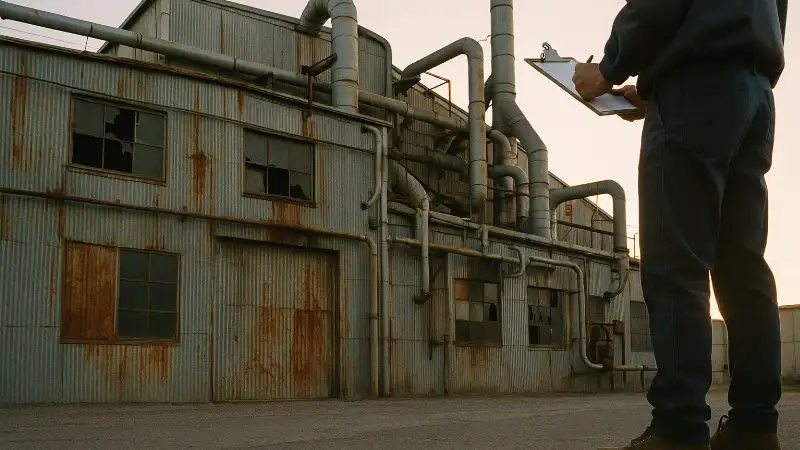
!Worker documents aging industrial facility at dawn with clipboard and recorder
What New Mexico's Asbestos Exposure History Means for Your Case
Spend any time reviewing the exposure sites directory for New Mexico, and a clear pattern emerges: the state's asbestos exposure history is concentrated in a handful of industries that employed generations of working-class New Mexicans.
The oil and gas sector in the San Juan Basin, centered around Farmington and Aztec, used asbestos-containing pipe insulation, gaskets, and valve packing extensively through the 1970s. Workers at these facilities — drillers, pipefitters, welders, and maintenance crews — had prolonged, high-intensity exposure to asbestos fibers. Many of the companies that supplied those materials are now defendants in ongoing litigation or have established bankruptcy trusts.
The federal government's presence in New Mexico created another major exposure pathway. Sandia National Laboratories and Los Alamos National Laboratory, both of which expanded rapidly during and after World War II, used asbestos extensively in laboratory construction, insulation, and fire-resistant materials. Workers at these facilities — and the contractors who built and maintained them — were exposed for decades. What the courts have consistently recognized in these cases is that federal contractor defendants face a specific legal framework, and navigating that framework requires attorneys who understand the nuances of government contractor immunity defenses and how to defeat them.
The construction industry across Albuquerque, Santa Fe, and the Rio Grande corridor represents the third major exposure category. New Mexico's building boom from the 1950s through the 1980s used asbestos in virtually every phase of construction. Electricians, plumbers, drywall workers, and general laborers all had regular contact with asbestos-containing materials. Many of those workers are now in their 60s, 70s, and 80s — the age range at which mesothelioma most commonly presents, typically 20 to 50 years after initial exposure, according to the National Cancer Institute.
Understanding which exposure sites are linked to which defendants, and which defendants are solvent versus bankrupt, is the kind of institutional knowledge that separates a highly effective New Mexico mesothelioma lawyer from a generalist personal injury attorney who occasionally handles asbestos cases.
What to Look for When Hiring a New Mexico Mesothelioma Lawyer
Not every attorney who advertises mesothelioma representation is equipped to handle the complexity of these cases. The families who achieve the best outcomes are the ones who ask the right questions before signing a retainer.
First, ask specifically about the attorney's experience with New Mexico asbestos exposure sites. A lawyer who has handled cases involving Kirtland Air Force Base, the San Juan Basin energy sector, or Albuquerque construction worksites will have pre-existing knowledge of the relevant defendants, product histories, and trust fund eligibility criteria. That knowledge accelerates the case and reduces the risk of missing a compensable exposure.
Second, ask how the firm handles the intersection of trust fund claims and litigation. According to RAND Corporation research, the most financially significant recoveries in mesothelioma cases typically involve both a litigation settlement and multiple trust fund distributions. A firm that only pursues one pathway is leaving money on the table.
Third, ask about the firm's approach to expedited case handling for patients with limited life expectancy. Most states, including New Mexico, allow for trial preference motions in cases involving terminally ill plaintiffs — a procedural mechanism that can move a case to trial within months rather than years. An experienced mesothelioma attorney will file that motion as a matter of course. According to Law360's asbestos litigation coverage, trial preference motions have become increasingly common and increasingly successful in jurisdictions with active asbestos dockets.
Finally, understand the fee structure. Virtually all mesothelioma attorneys work on contingency, meaning they collect a percentage of the recovery only if the case succeeds. There should be no upfront costs to the family. If an attorney is asking for money before a recovery is obtained, that's a significant red flag.
Families can also use the compensation estimator tool to get a preliminary sense of what a case might be worth before the first attorney consultation.
The Legal Landscape for New Mexico Asbestos Victims in 2026
The legal landscape for asbestos victims in New Mexico has shifted in several important ways over the past few years, and those shifts have real consequences for families navigating a new diagnosis.
Nationally, asbestos litigation continues to generate significant verdicts and settlements. According to Bloomberg's asbestos legal coverage, juries in several jurisdictions have returned verdicts exceeding $10 million in individual mesothelioma cases in recent years, particularly in cases involving defendants who continued to use or sell asbestos-containing products after the scientific consensus on its dangers was well established. The legal landscape for asbestos victims has become more favorable in many respects, as courts have grown more sophisticated in understanding the long latency period between exposure and diagnosis.
At the same time, the bankruptcy trust system continues to evolve. Some trusts have reduced their payment percentages as claims volume has increased, while others have been replenished or restructured. According to the RAND Corporation's analysis of asbestos trust fund structures, the timing of trust claims can affect the total recovery — a consideration that underscores the importance of filing promptly and strategically.
For New Mexico families specifically, 2026 brings a practical urgency. Workers who were exposed to asbestos during the construction boom of the 1960s and 1970s are now in their 70s and 80s. Many are receiving diagnoses now. The three-year statute of limitations means that families who delay — even by a few months — risk losing their right to file entirely. According to litigation analysts at the National Law Review, missed statutes of limitations are among the most common and most devastating legal errors in asbestos cases, and they are almost always preventable with timely consultation.
For a family like Carlos Medina's, the path forward starts with a single phone call to an attorney who knows New Mexico's courts, New Mexico's exposure sites, and New Mexico's industrial history. The answers to compensation questions are available. The full picture of what mesothelioma means legally and medically is within reach. What matters most, in the weeks after a diagnosis, is not waiting to find out.

What Should New Mexico Mesothelioma Patients and Families Do Right Now?
The first 90 days after a mesothelioma diagnosis are the most legally consequential — and often the most emotionally overwhelming. Here is what an experienced New Mexico mesothelioma attorney will tell you to prioritize.
Document everything immediately. Work history, military service records, union membership, employer names, co-workers who can corroborate exposure — all of it. Memory fades, and witnesses become harder to locate over time. A detailed written account of every job held, every worksite visited, and every product encountered is the foundation of a strong case.
Seek a specialist, not a generalist. A personal injury attorney who handles car accidents and slip-and-falls is not equipped to navigate the complexity of mesothelioma litigation. Look for a firm with a dedicated asbestos practice, a track record of New Mexico cases, and attorneys who can speak specifically about exposure sites in your region.
Don't assume a national firm is the best choice. Large national mesothelioma firms have handled thousands of cases, but their volume-driven model can mean less individualized attention and less familiarity with New Mexico-specific defendants and exposure histories. A firm with genuine New Mexico experience may achieve a better outcome for your specific case.
Act before the statute runs. Three years sounds like a long time when you're managing a terminal diagnosis, chemotherapy schedules, and family logistics. It isn't. Cases require extensive investigation, and the earlier that investigation begins, the stronger the resulting claim.
In my experience representing mesothelioma families, the families who engage legal counsel early — within the first 60 to 90 days of diagnosis — consistently achieve better outcomes than those who wait. Not because the law rewards speed for its own sake, but because early action preserves evidence, protects witnesses, and keeps all legal options open.
Attorney Advertising. Past results do not guarantee future outcomes. Every case is unique. The verdicts and settlements described are not a guarantee of similar results. Every case is different.

Comments (1)